
How to Teach Kiteboarding to Small Children

… or how my son taught me more than I taught him.
The Goal Was Clear – Teach My Son to Ride as Soon as Possible
Anyone who knows me knows I love kiteboarding. Correction: we love it both – I and Jíťa (my partner and the mother of our little clones). It’s our passion, something we’ve been doing together for years. I like to call our trips “adventures with our little team.”
When my son was born, I was determined to introduce him to kiteboarding as early as possible. In my dreams, we were already racing across Greek flats when he was four, with me showing him how to pull off tricks.
Lack of Interest
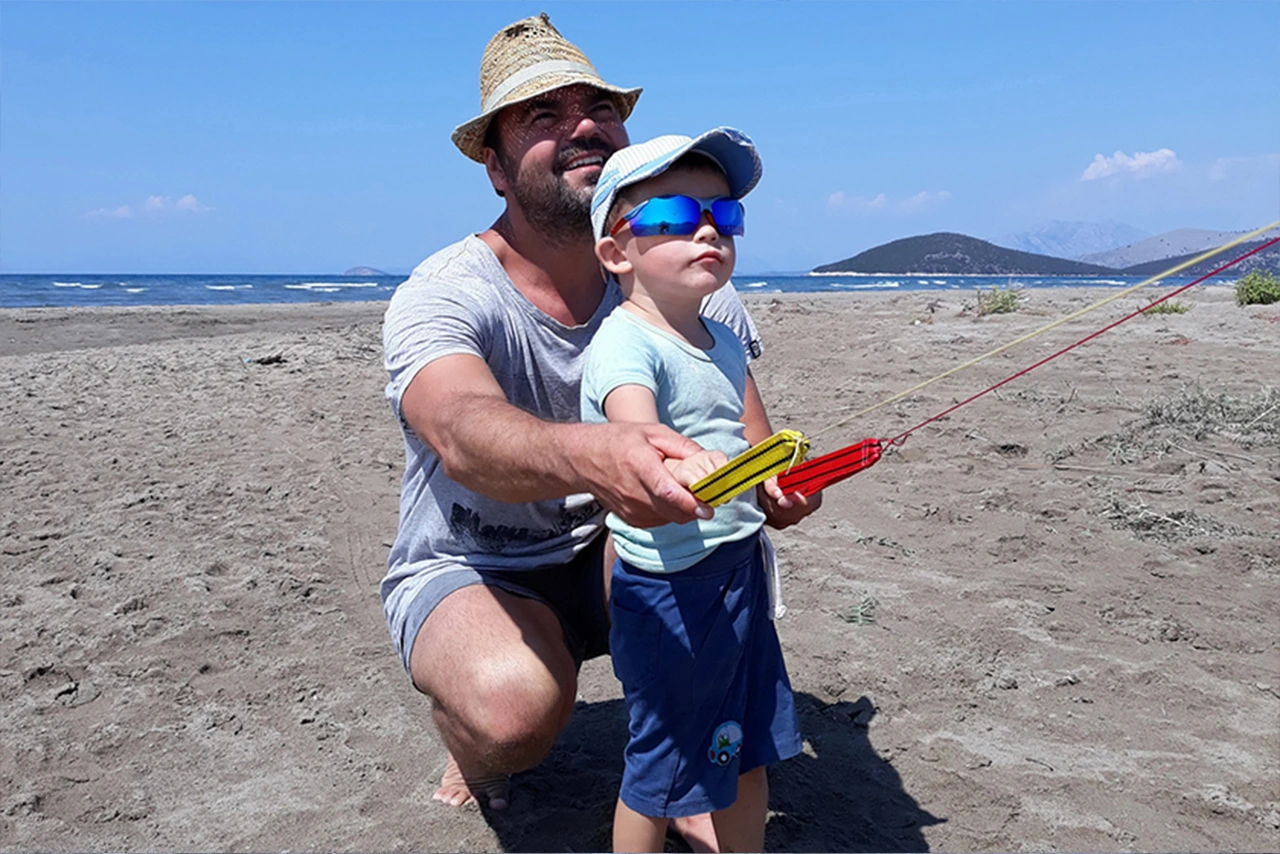
Time passed. Six, seven, eight years old—and my son still wasn’t interested in kiteboarding. It was all about Lego, dinosaurs, and trading cards. My friends would call and ask how he was progressing. “Our six-year-old daughter is already riding,” they’d say. “She loves it.” Another friend’s son had started kiteboarding at seven.
I have to admit—it hurt. I didn’t understand it. I kept thinking, He sees us all the time, watching his mom and me come out of the water with huge grins on our faces. How could he not be drawn to it? But he wasn’t.
Every trip, I packed a small kite, a board, a harness for him. And every trip, they just lay in the car, taking up space. Every time, I told myself, That’s it. I won’t bring them again. If he wants to try, he’ll have to ask me three times before I bring the gear next time.
I kept thinking about my own experience. I didn’t start snowboarding until I was 30. For ten years, a friend had been pushing, persuading, convincing me to try it, saying it was incredible. But I refused—I was a skier. And while I love snowboarding now, I started too late. How much better could I have been if I’d learned at an age when fear wasn’t holding me back?
Greece, Fall 2024
I kept worrying, brainstorming, consulting with others—until I finally gave up. This year, I told myself I wouldn’t stress over it anymore. It was his journey, and if he had no interest in kiteboarding, that was his choice. Besides, at least I’d have more time on the water for myself.
With this mindset, we headed to Greece for our fall trip. Jíťa and I spent a lot of time on the water—freestyle, foil, wingfoil. We were both pushing ourselves pretty hard. Then, during a seemingly harmless little stunt, Jíťa injured her knee. At that moment, her kiteboarding trip was essentially over.
We still had about three weeks left, and I was worried she might want to go home. Thankfully, she didn’t—so I actually got even more time on the water.
Relentless Besný
Then Besný arrived—we call him “Besný,” a name that means relentless, fiercely determined, and always pushing forward with unstoppable energy. He’s a friend of ours, and for the past two seasons, we had been trying (unsuccessfully) to teach my son together. Besný came up with all sorts of motivational tricks involving dinosaurs and remote-controlled cars, which usually worked for a day—then nothing. Eventually, I put a stop to it. He can buy a car for my son once he actually starts riding, but not before.
But this year, Greece felt different. I had already spent a ton of time on the water, Jíťa wasn’t riding, and Besný was getting bored and looking for ways to entertain himself. I thought to myself—If not now, then when?
Nafpaktos
As it often happens, luck—or rather, a fortunate chain of events—ended up helping us. On one hand, it was the way our little team was set up. On the other, the conditions of the Greek autumn pushed us to a spot we hadn’t even considered. The wind had died down at Raches and Flatland, and a storm had destroyed the sandbar at Drepano, leaving no flat water at all. Where to go? We decided to give Nafpaktos a try.
And that’s where everything fell into place—the trip suddenly had a new energy. The wind was lighter in the morning, gradually building up during the day, peaking from around 2 to 4 PM before easing off again. Plus, there was a sandy shallow area, steady wind for two full weeks, and plenty of space. The locals only showed up in the afternoons, which meant we had the spot mostly to ourselves. The perfect place to learn.
Small Progress
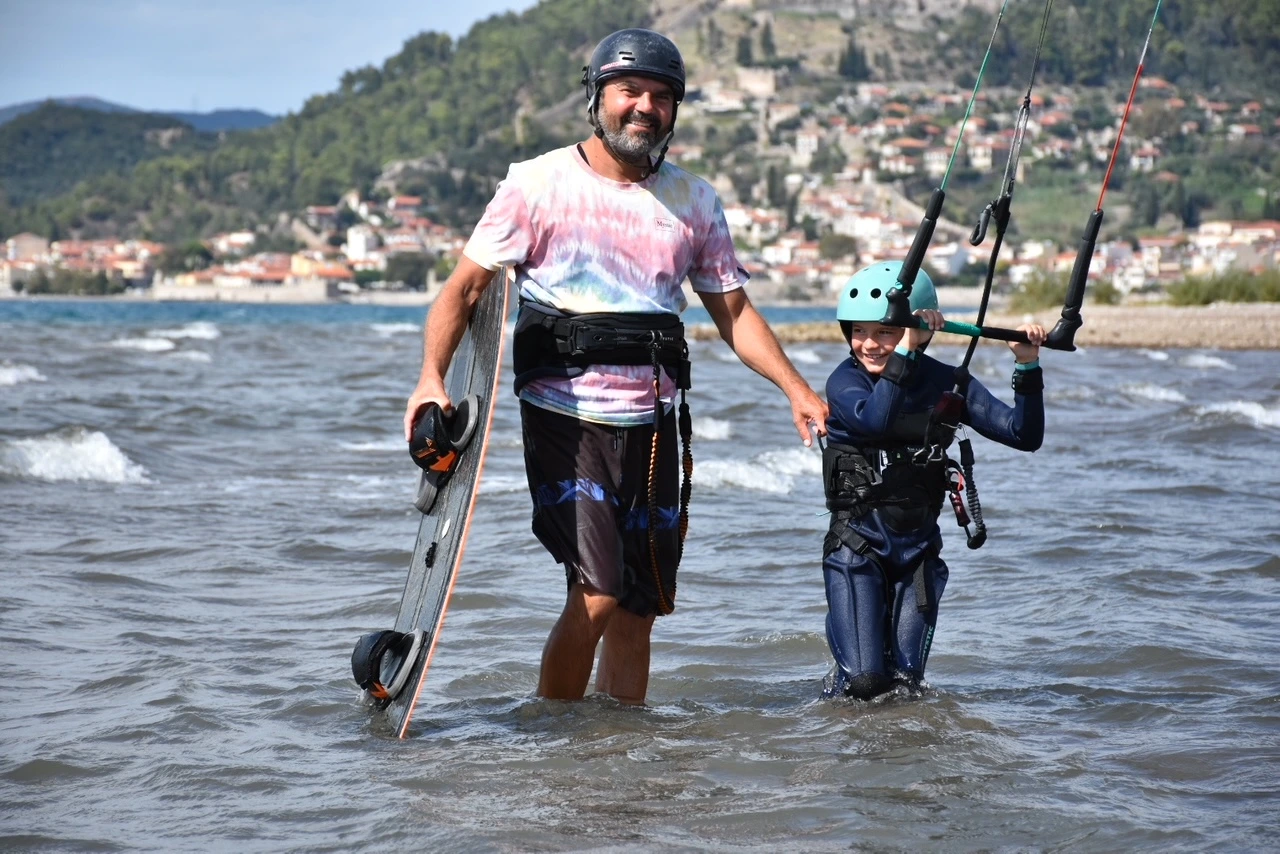
The spot was so perfect for learning that I completely lost my mind again. I had to force myself to stay calm whenever my son refused to go in the water with the kite. He loves the water—so much so that even in the cold (I was riding in a wetsuit), he’d spend long minutes, even hours, playing in the waves. Yet his excuse for not wanting to go in with the kite? “It’s too cold.”
I have to admit, at that point, I started coming up with every possible strategy to get him in the water with the kite. Looking back, I’m a bit ashamed—I resorted to tricks, persuasion, threats, pressure, and all those classic “loving parent” tactics.
In the end, I managed to get him in the water every day for about twelve days straight. But each time, it lasted only about half an hour. Still, I was beyond happy. And despite my earlier vow, of course, I had all his gear packed in the car.
I hope you’ll read this someday, son—when you’re grown up and I’m old. By the way, I expect long-term free elderly care from you. I’m talking full service—wiping my butt and all that. No one has ever had the kind of luxury you did while learning to kiteboard. One reluctant student, surrounded by four enthusiastic helpers. I controlled the kite, held you up, and strapped the board onto your feet. Besný ran alongside you, keeping your front foot above the water—honestly, he carried you more than he let you ride. Mom helped relaunch the kite whenever it crashed. And Fáfa (sister) fetched your board every time you lost it.
Falls, Tears and a Breakthrough Moment
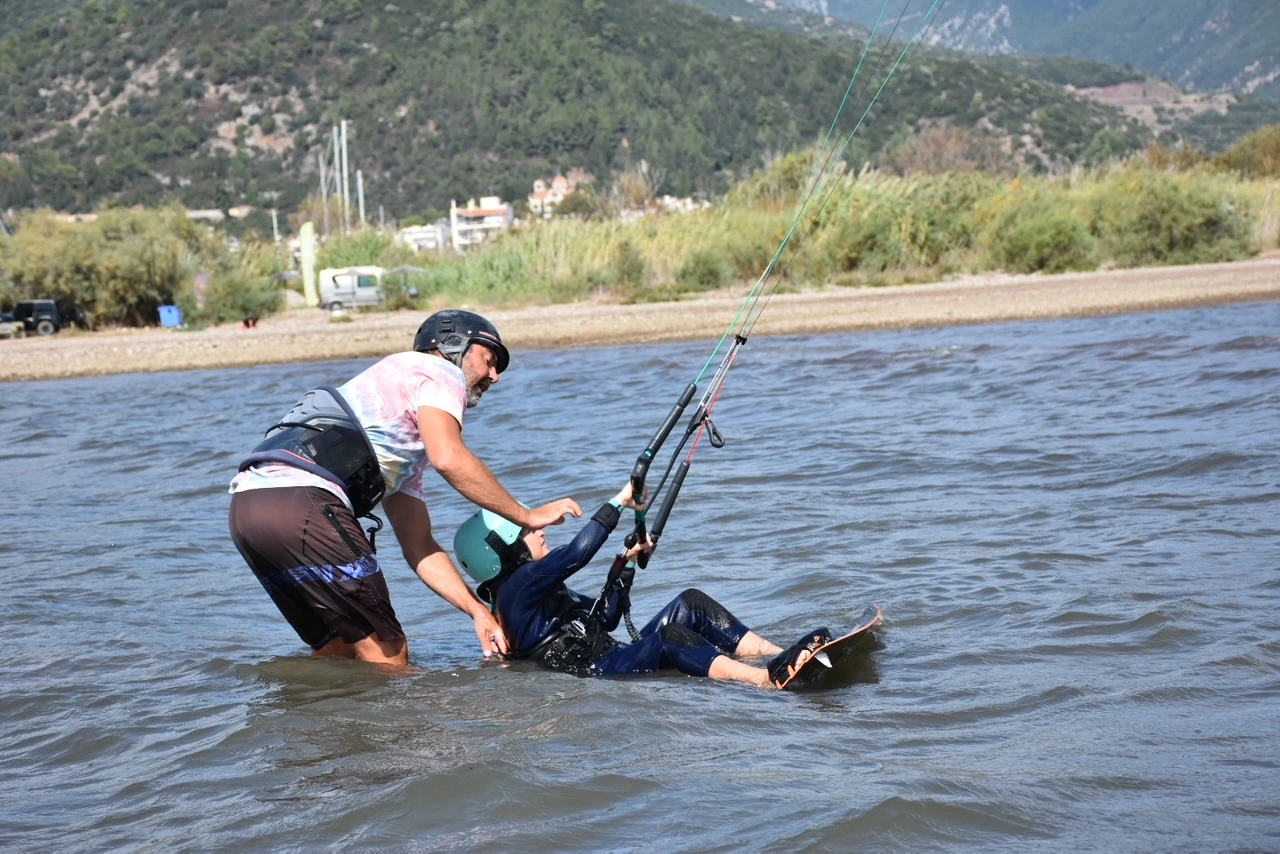
This went on for a week—until Besný had to leave. Suddenly, there was no one left to run alongside my son and help him. So we switched to a new system: “I’ll help you with the start, but from there, you’re on your own.”
To my great surprise, it worked. By then, he had already spent so much time flying the kite that handling it was second nature. That meant he could finally focus on his body and the board.
Within two days, he started riding on his own, and from that point on, things got a lot more fun. Of course, there were crashes—but luckily, none of them ended badly. There were a few tears, and it was my job to dry them and restore his sense of safety and confidence.
Then came one particularly spectacular faceplant—a forward dive, launching about three meters through the air before planting his face into the water and sand. This time, the tears were bigger, and it looked like he might call it quits for the next few days.
That’s when I had to pull another trick. I said, “Hey son, do you know why crashes like this are actually a good thing?” He looked at me, totally puzzled. “Because now you have something cool to talk about in the evening with the kiters. No one brags about making a smooth turn—kiters talk about their best wipeouts!”
I could see the gears turning in his head. Then he asked, “Was that the kind of crash I’ll be able to tell stories about someday?”
From then on, every evening, we’d talk about his rides and his crashes. I could see that he was enjoying it—even though he never wanted to go out on the water during lesson time, he always came back excited afterward.
That’s when it hit me—maybe, just maybe, he was becoming a kiter after all.
Son, if you’re reading this … Here’s where you stood in the fall of 2024, at the age of 9 years and 3 months. You launch on your own, ride in both directions, manage to go upwind, turn, and ride back. Small waves don’t bother you, and you handle the kite pretty well. In shallow water, you can even relaunch the kite from the water. But—you can’t fall and lose your board yet. You still can’t strap it back on by yourself. That’s when Dad has to run over and help you. We’ll work on that next time.

A Lesson for Dad: It’s About the Journey, Not the Destination
I have to admit—this experience probably taught me more than it taught my son. Most importantly, I learned that when teaching your own child, the relationship matters far more than the result. I love kiteboarding, but to truly enjoy teaching him, I had to make peace with the possibility that he might never fully embrace it.
We’ll see what happens next. This winter, I’d love to take him to the mountains—he enjoys skiing, so hopefully, that will go well. But honestly, I’m more excited for spring. Water is water, after all. I’ll keep you posted.
Aloha, and may the wind be with us!
— Přemek
P.S. The other night, as I was tucking him in, he said, “Dad, do you know what I’m looking forward to?”
“Kiteboarding!”
At that moment, I was floating ten meters above the ground.
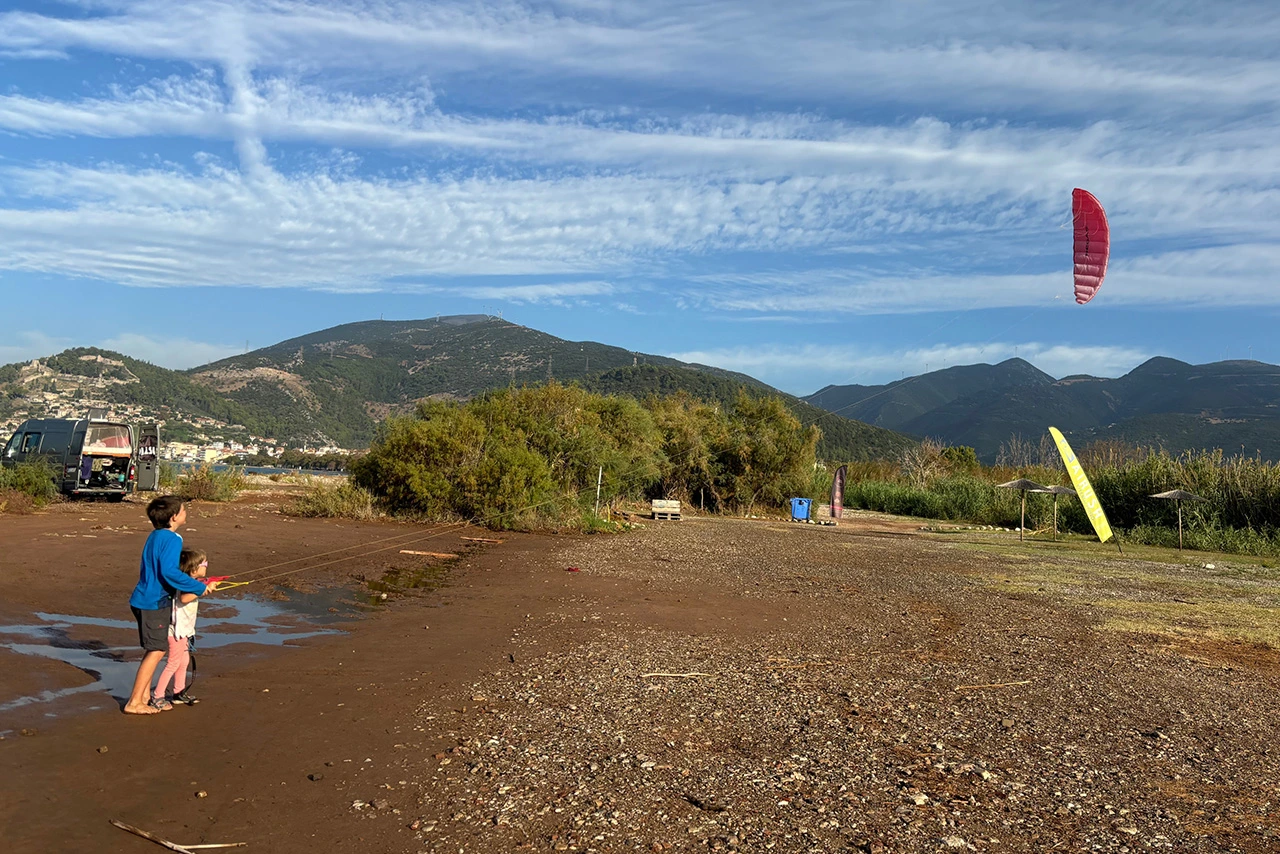
P.P.S. And what about the other little clone, Fáfa? She’s been excited about kiteboarding for a long time, but she’s still so tiny that even the training kite lifts her off the ground. On the other hand, she’s been talking about it for two years now and has serious drive.
So, we’ll see.
Tips and Tricks for Parents: Teaching Your Own Kids
I intentionally write about teaching your own kids because it’s a different discipline than teaching other people’s children or even adults. When you teach someone else’s child, the teacher doesn’t project all the experiences with the child, plans, dreams, but also fears and doubts (mostly about themselves).
Our starting point: Přemík is cautious, not exactly a speedster. I don’t need to hold him back; rather, I have to support him and push him into action. When he’s motivated, he can be persistent and passionate. If he’s not motivated, nothing will work. If I push him, I usually get the opposite result. He’s pretty skillful motorically, but he’s afraid of hurting himself. He likes the water, isn’t afraid of it, and is a good swimmer and diver.
A Few Tips I Consider Essential When Teaching Kids
- Wait for the moment when the child comes on their own. The best and fastest way for a child to learn is when they truly WANT to. Kiteboarding isn’t rocket science—if a kid is motivated, they’ll pick it up in no time. But if it’s just dad who wants it, that’s not much of a motivation. The fact that a child will come on their own can be achieved in a group of children, where some are riding and others are not.
- PATIENCE, PATIENCE, PATIENCE! Don’t push too hard, don’t yell, and don’t lose your temper. It might sound obvious, but trust me, it’s not. Parents, especially dads (but moms too), can get pretty worked up when things don’t go according to plan. I struggled with this a lot myself. It’s better to wait a whole year for a happy and confident kid than to push too soon and end up with a crying one. A kid who has a bad first experience probably won’t want to continue later.
- Make it a game. Kids don’t want to “learn,” they want to have fun. Do whatever it takes to make it enjoyable.
- Adapt the lesson length to your child’s needs. For us, half an hour a day was the perfect amount of time. It takes patience and parental endurance to go into the water every day just for half an hour (sometimes twice a day), but in the end, it paid off. Even if the session is short, don’t stretch it too much. It’s important to know when to stop.
- Slowly help them overcome their fears (and their mom’s too!). I could see that my son was scared. Saying “Don’t be afraid” didn’t work for him. Instead, I told him: “I’m here with you, I’m watching you.” I also shared that I was scared too when I started. Even now, on a new spot, I get butterflies before launching my kite. Fear is good—it keeps you alert, I told him. I also made sure he saw that falling isn’t the end of the world.
- Make sure you don’t lose their trust. Do everything you can to avoid situations that are dangerous or deeply unpleasant for them.
- Praise their effort, not just results. Progress in kiteboarding isn’t always immediately visible. But a good attitude is. There’s always time for criticism later—focus on the positives first.
- Left and right can be tricky. A purely technical note: kids (and many adults) struggle with left and right. It’s much easier to use colors (red/green) or say “towards the shore / out to sea.”
- Enjoy it! One day, you’ll look back on this as the start of an amazing journey.
The article was translated with the author’s permission from Mystic Blog.
You can buy perfect kiting equipment from Mystic and North in Czech Mystic Store. Delivery all over the Europe without any problems.

Author: Spots4Kite
The team behind Spots4Kite.
