
Kitesurfing glossary: Exploring Wind and Water Terms

Enjoy kitesurfing to the fullest. But to do so, you need to understand two fundamental elements of this sport: wind and water. It is also important to know the various risks and avoid injuries or unpleasant rides that you would endure rather than enjoy. In this article, we will describe everything you need to know.
It is necessary to understand the basic concepts and terms that describe the state or behavior of the wind and water, from wind direction and wind strength to various types of water conditions.
Wind
The wind is the primary element in all types of kiting, as it generates the necessary propulsion and power for kiters. Understanding wind conditions is therefore crucial for kitesurfing. The strength of the wind affects the choice of kite size or board selection. The wind direction determines which way to ride depending on local conditions.
The wind, as the main factor, also affects safety when practicing kitesurfing, and every kiter should be able to assess whether the given wind conditions are manageable for them or not.
For every kitesurfer, three main factors of the wind are of interest: wind speed/strength, wind direction, and wind consistency.

Speed / Wind strength
The speed and strength of the wind are crucial factors for kitesurfing, as they directly affect the performance of the kite itself and the ability to move on the water.
The basic unit of wind speed for kitesurfers is the Knot, 1 knot ≈ 0.514 m/s.
Depending on the wind speed, you will most often encounter the following terms:
- Light / Low Wind (below 10 knots) – a weak wind that, with the use of appropriate equipment, still allows the kite to stay in the air and the kiter to be able to ride. It is generally considered to be in the range of 6-10 knots, and in this wind, you will most often encounter foil kiters on the water.
- Pleasant Wind (11 – 20 knots) – optimal wind, with which kitesurfing can be safely practiced using an appropriate kite size, suitable for both beginners and advanced riders.
- Strong Wind (21 – 30 knots) – a strong wind sought primarily by advanced riders for performing various jumps and tricks, especially suitable for the Bigair discipline.
- Wind 30 and more knots – is highly coveted by adrenaline enthusiasts for breaking various records, most commonly in the big air style.
Wind direction
The wind direction is the second important factor in kitesurfing because it affects the direction in which you will ride. Wind direction is especially important for assessing the suitability and safety of a particular location for kitesurfing.
When describing wind direction using compass points (e.g., in forecast models), the direction from which the wind is coming is always indicated. For example, wind blowing from the east towards the west is called an east wind and will be represented by the letter E.
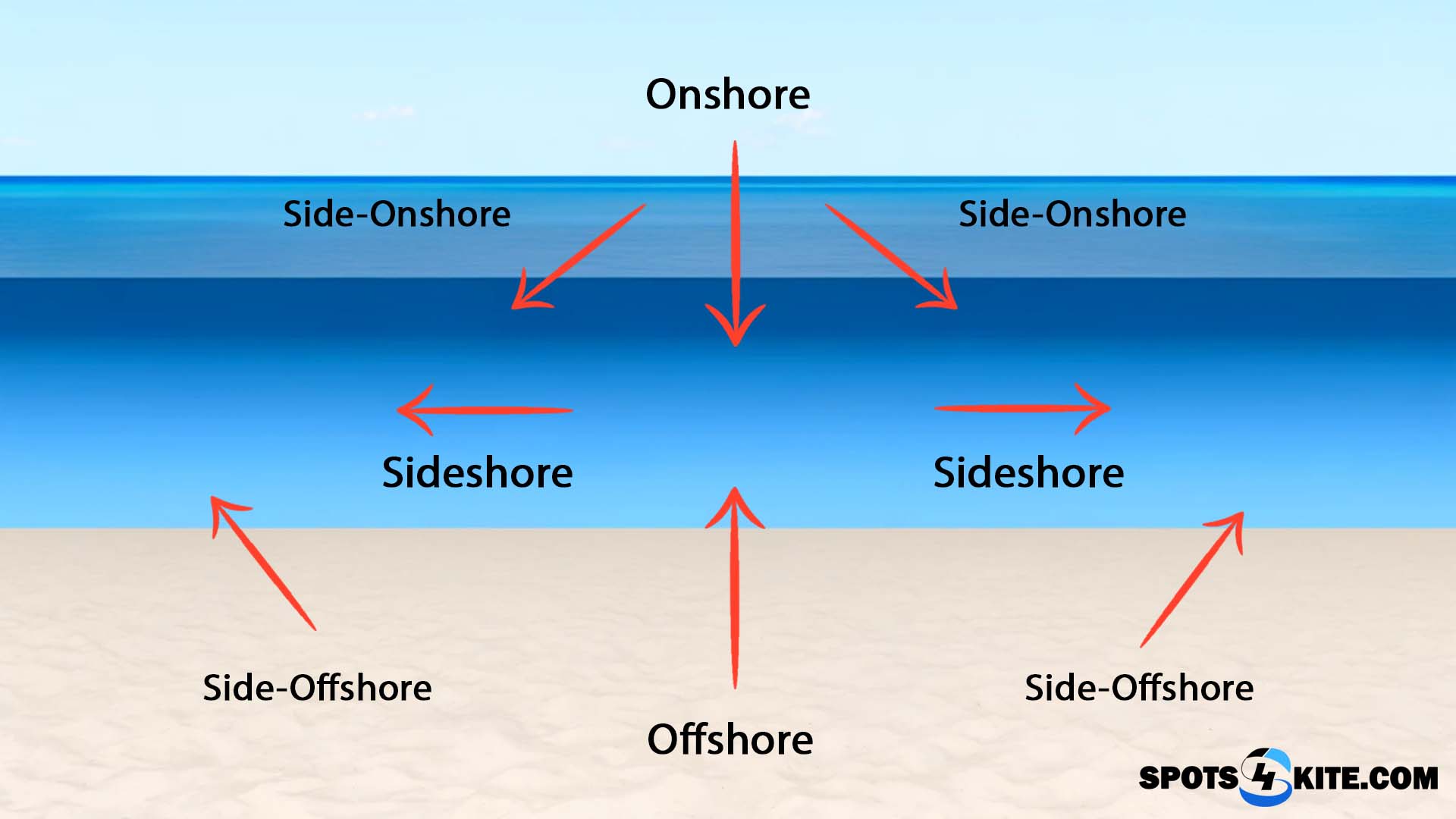
The directions of the wind in relation to the shore
- On-shore: When the wind is blowing from the water towards the shore, at an angle of 90°.
- Side-On-shore: When the wind is blowing from the water to the shore, at an angle of 45°.
- Side-Shore: When the wind is blowing parallel to the shore line (along the beach). The direction of the wind along the shore can pose a risk, especially in long bays or channels in combination with ocean currents.
- Off-shore: When the wind is blowing from the shore towards the water at an angle of 90°.
- Side-Off-shore: When the wind is blowing from the shore to the water at an angle of 135°.
Both Onshore and Side-Onshore directions are the best wind directions for kitesurfing. Wind blowing from the sea tends to be more stable and smoother. For the kiter, both directions are safe because they will always return to the shore in case of trouble.
For beginners and for learning, the best direction is Side-Onshore, where the kiter moves with the wind and along the beach, and can return to the starting point on foot. Pure Onshore direction combined with deep water is not suitable for beginners who have not yet mastered riding upwind, to be able to ride away from the shore to a safe distance.
Offshore wind directions blowing from the land tend to be more gusty and variable, as the air mass passes over obstacles on the land, presenting the greatest risk for kiteboarders. In case of any difficulties while riding or equipment failure, the kiter is carried out to the open sea (water). With an offshore direction, the kiter should be 100% confident in their abilities and equipment, not ride alone, and have backup assistance on land (such as a boat). The greatest danger is on ocean islands, where wind, waves, and water currents can pull a kiter without a kite overhead irretrievably away within just a few minutes.
Direction of riding relative to the wind
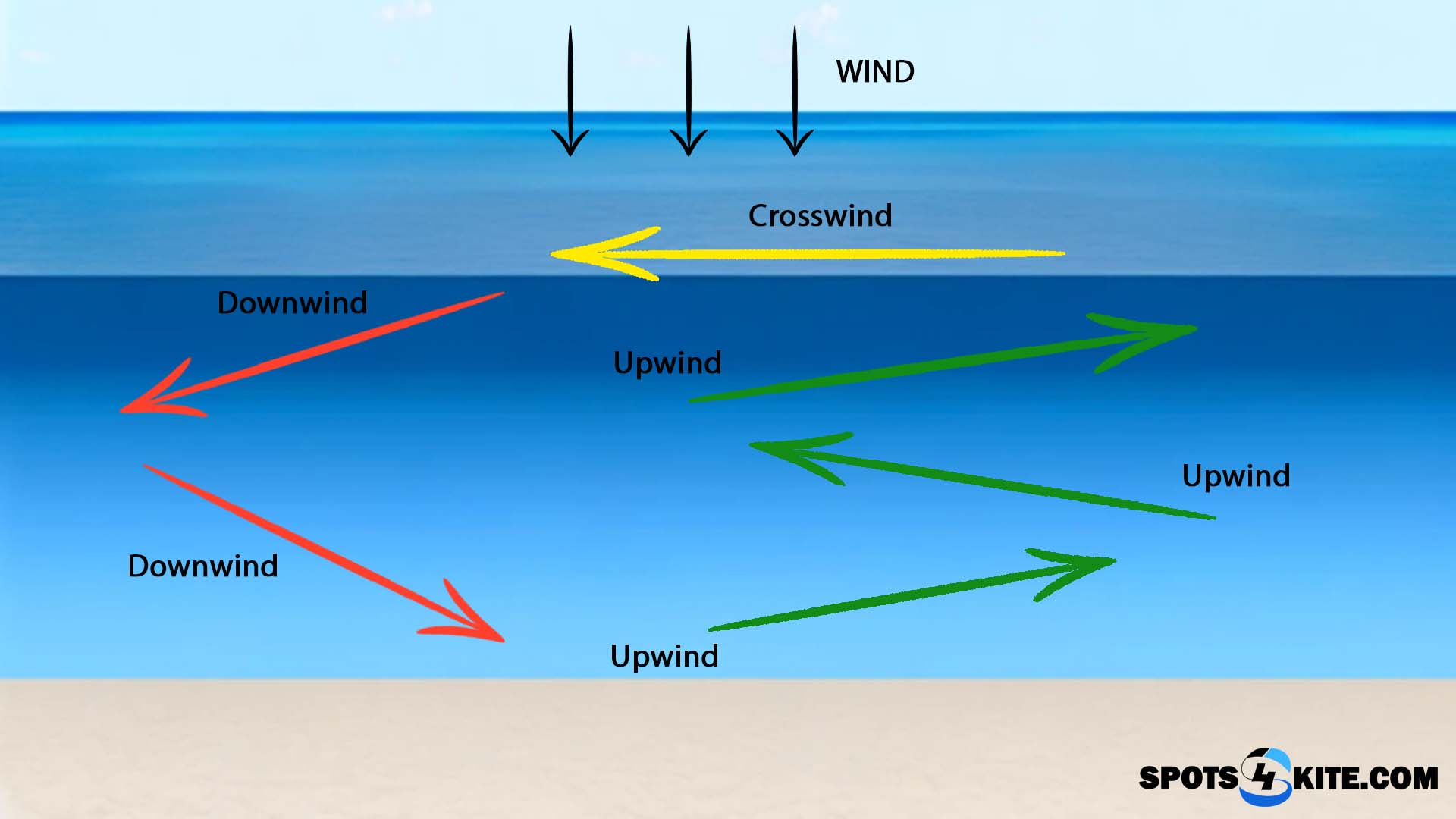
- Upwind – Riding against the wind direction. The ability to ride against the wind is a fundamental requirement for kitesurfing. It is a key skill that every beginner must master to be able to ride independently and return to the starting point on the beach. Once you can ride upwind, you won’t have to take the “Walk of Shame” after every ride, returning on foot along the beach with the kite overhead. But every kitesurfer must go through this phase.
- Downwind – Riding with the wind direction. An easier and faster way of riding on a kiteboard. However, you must not let your kite and board drift too far downwind, as there is a risk that the lines will lose their tension and the kite its power.
- Crosswind – Riding perpendicular to the wind direction, across the wind.
While it is theoretically possible to ride at up to a 40 degree angle to the wind, in practice with normal equipment 10 to 20 degrees upwind is achievable. The ride depicted graphically would look something like this:
Consistency and stability of the wind
The third and no less important factor that influences both the choice of a suitable kite and the safety for kitesurfers on the water is the constancy and stability of the wind.
Stability of the wind
- Steady wind is a wind with small fluctuations allows for a pleasant ride with minimal risks. Even stronger stable wind can be safely managed with the appropriate kite size.
Unstable wind means significant discomfort for a kitesurfer because the kite can pull too hard at times and too little at other times, which unpleasantly affects the overall riding experience. Usually, wind fluctuations can be corrected directly on the kite using the Depower Trim Adjustment. Unstable wind can also pose a serious safety risk if its strength suddenly drops enough for the kite to start falling on its own. Or the wind can strengthen so much that the rider starts to lose control over the kite.
- Gusty wind adversely affects the pull of the kite, and the kite may behave unpredictably. Gusts up to 5 knots are manageable without major issues.
Thermal wind
The basic principle of thermal winds, also known as sea breezes, occurs when there is a temperature contrast between the land and the sea. These temperature differences lead to variations in air pressure, causing wind to flow from areas of high pressure to low pressure, typically from the cooler area above the sea to the warmer area above the land.
Thermal winds blowing from the sea to the land tend to be more stable with fewer fluctuations. In certain locations, they occur repeatedly and start blowing at the same time each day. Therefore, thermal winds are ideal for kitesurfing. Thermal wind conditions can range from very light to strong. Particularly strong to extreme conditions may occur when thermal winds are reinforced by frontal winds.
Frontal wind
The principle of the formation of frontal winds lies in the interaction between two air masses with different temperatures and pressures. Frontal systems, such as warm and cold fronts, bring changes in weather and consequently changes in wind conditions. As the front moves, the warmer air rises above the cooler air, creating pressure differences and subsequently winds that move from the area of higher pressure to lower pressure.
Frontal winds are generally unstable and can exhibit significant changes in intensity and direction. Their intensity and character can vary depending on the strength and type of front moving through the area. These winds can be strong to extremely strong, making them challenging conditions for kitesurfing.
Don’t forget the clouds
Clouds often provide us with important information about the wind we can expect. If we see dark clouds rushing in the distance, accompanied by thunder and lightning, we should never go on the water. However, the opposite can also happen: it’s windy, but in the distance, we see thick, low clouds that will most likely “kill” the thermal wind, reducing it from 15 knots to 0 in a matter of minutes. So, always watch the sky, even while riding. Turn into the wind, look at the sky, observe the horizon and the water, and if you notice anything concerning, return to the beach. It’s better to be cautious than injured, or worse. You can read more details about clouds and the sky here.

Wind measurement and forecast
Measuring the wind
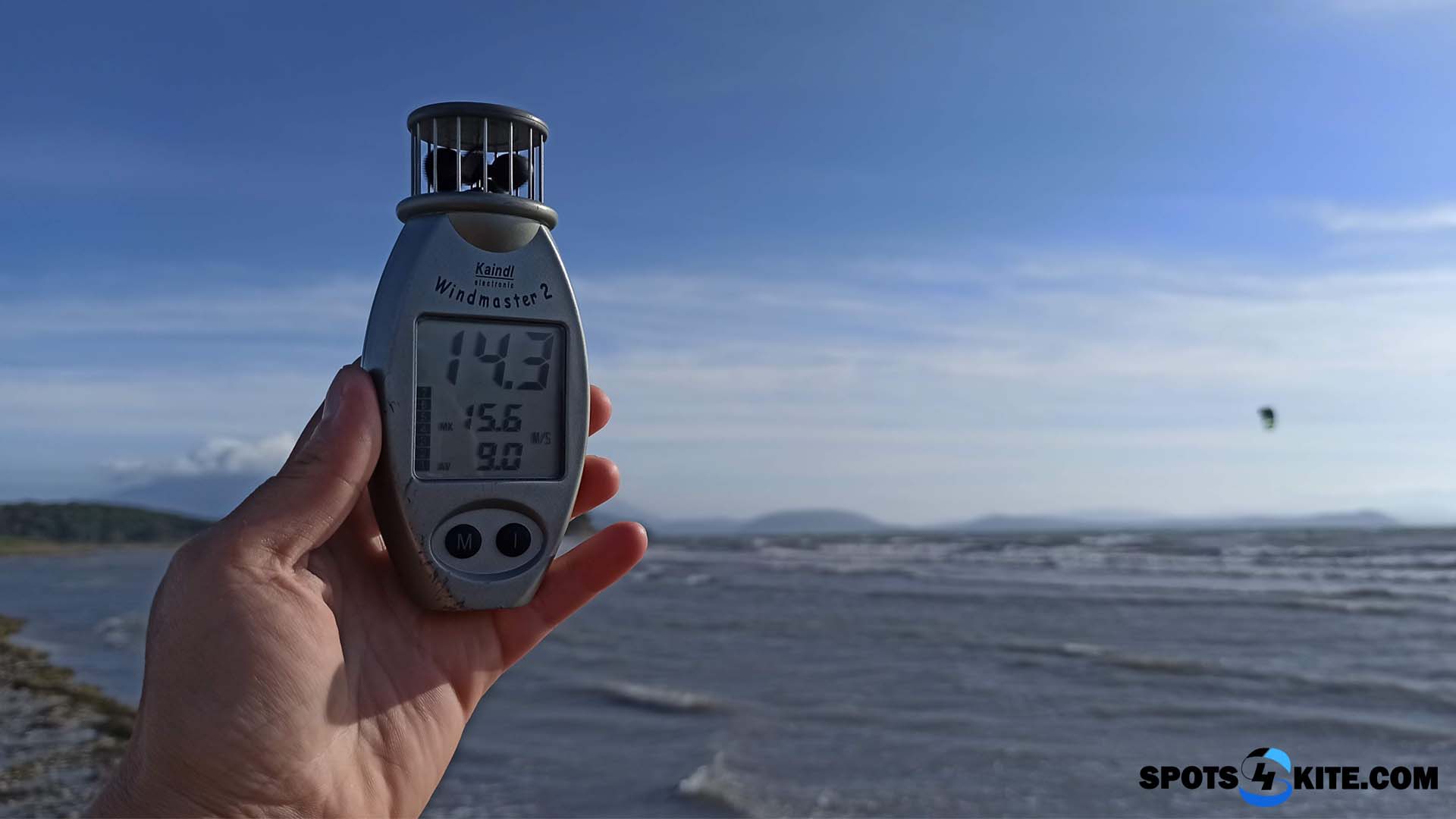
An anemometer is a device used to measure wind speed. It typically consists of several small blades that are placed on a rotating shaft and are moved by the wind. Sensors inside the anemometer convert this movement into wind speed values. Modern anemometers often contain electronic sensors and displays that allow precise measurement of wind speed in various units: knots, m/s, km/h.
Some kitesurfing schools and clubs on the beaches have their own meters, which send wind information to various applications. Or you can get your own pocket anemometer.
Always keep in mind that the values measured on the beach may not correspond to the values on open water further from the shore, where the wind is usually stronger by up to 2 knots.
Wind forecast
Being able to read weather and wind forecasts is essential for kitesurfing for several reasons. Correctly interpreting the wind forecast allows kitesurfers to choose the optimal location and time for their session on the water. The wind strength forecast is also important for safety and selecting the appropriate equipment.
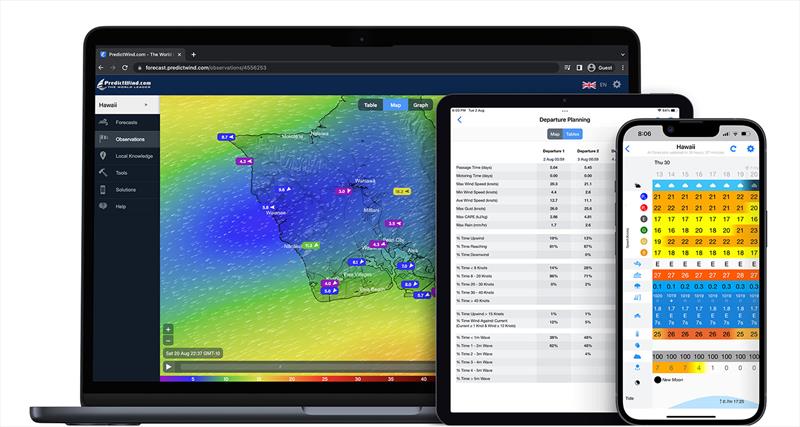
For wind forecasts, you can follow local or maritime forecasting models. In some countries or locations it is best to check the national forecasts on the internet (for example in Greece it’s great to follow the local sailing forecast). Alternatively, you can use a number of existing forecasting apps that combine multiple such models and are widely used today for various water sports. The most well-known worldwide are:
Windguru
Windguru is one of the most popular weather and wind forecasting applications among kitesurfers. It provides detailed forecasts including wind speed and direction, temperature, precipitation, and other meteorological information for thousands of destinations around the world.
Windy
Windy is another popular app for weather and wind forecasts, offering interactive maps with accurate visualizations of meteorological conditions. Users can track wind speed and direction, waves, temperature, and other parameters for different areas and times.
PredictWind
This application also provides detailed weather forecasts including wind speed and direction, waves, precipitation, and other meteorological conditions. It is popular for its accuracy and extensive coverage of areas around the world.
Wind Window
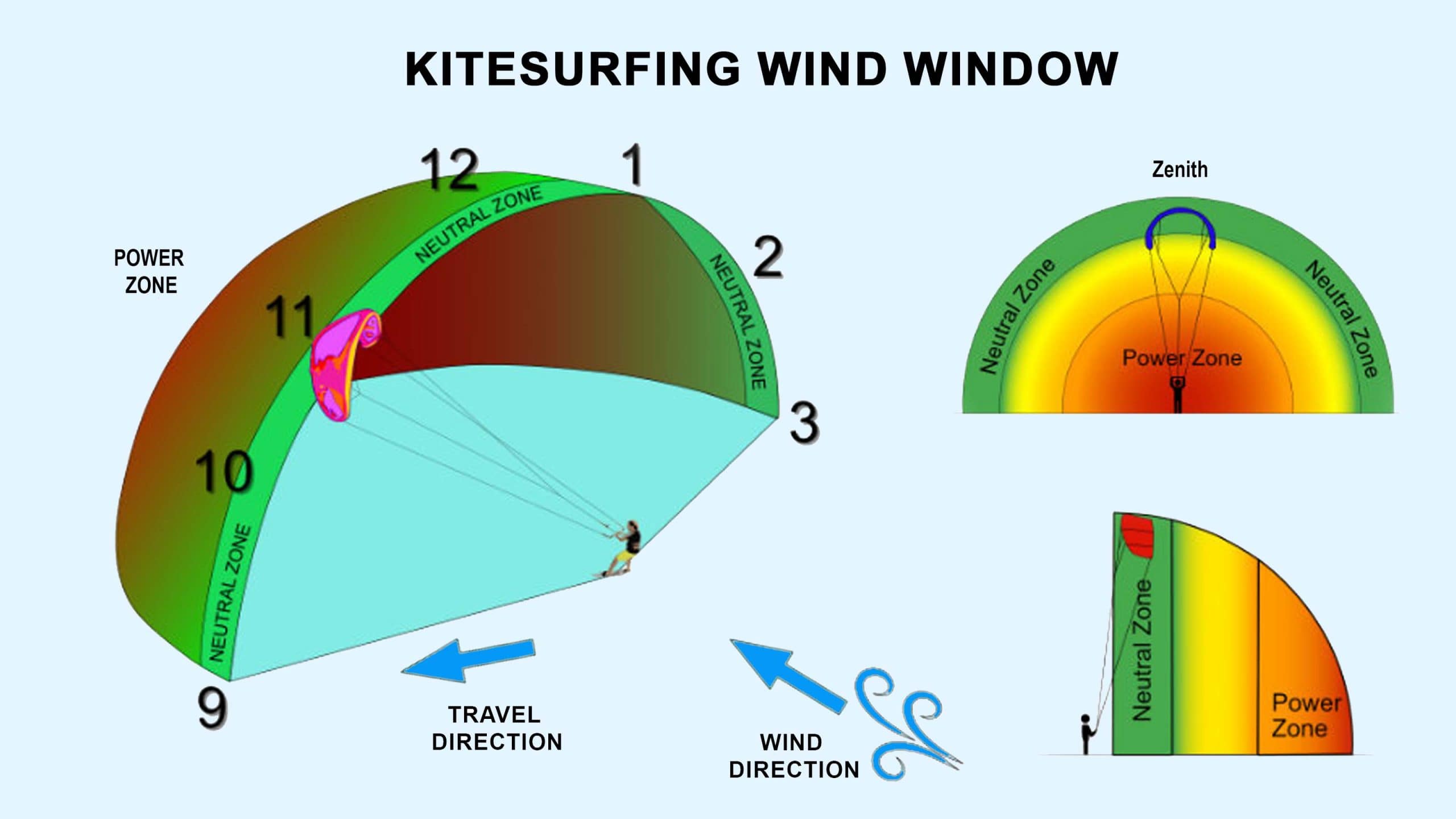
The wind window is a fundamental concept in kitesurfing that describes the three-dimensional space in which your kite can fly in relation to the wind direction. Understanding its shape and zones is essential for safe launching, controlled riding, and power management.
The wind window is shaped like a quarter dome or vault, extending downwind from your position. To visualize it, stand with the wind at your back and stretch your arms out to the sides. The kite can fly in the area in front of you — this is the wind window. Its actual size depends on the length of your lines. For example, if you’re using 20-meter lines, the wind window will extend approximately 20 meters from your position to its perimeter.
Edge of the Window (Neutral Zone)
The outer edges of the wind window — roughly at the 9 o’clock and 3 o’clock positions — are called the edge of the window or neutral zone. In this zone, the kite generates minimal power and will mostly hover or float with little to no pull. This is the safest area for launching and landing the kite, and also the best place to keep your kite when you’re standing still or adjusting your gear.
Power Zone
The central area directly downwind in front of the rider is known as the power zone. This is where the kite generates the most power due to its position and speed relative to the wind. The power increases progressively as the kite moves from the neutral edge toward the center of the window. Many instructors divide the window into colored zones (green = safe/neutral, yellow = moderate pull, red = high power) to help students visualize the changing force.
Flying the kite quickly through the power zone (for example, during a waterstart or jump) creates a strong pull that can lift or accelerate the rider. Beginners should avoid spending too much time here unless they’re actively riding and prepared for the force.
Zenith
The zenith is the vertical position directly above the rider — also called 12 o’clock. At zenith, the kite is at the top of the wind window. This is often a resting or neutral position, especially used while standing on the beach or preparing for water entry. However, in strong wind, keeping the kite parked at zenith can be risky due to instability or sudden gusts.
Clock Positions
To describe kite positions within the wind window, kiters use clock terminology. Imagine the wind window as a giant half-clock in the sky:
- 12 o’clock is directly above you (zenith).
- 9 o’clock is on your left (edge of the window).
- 3 o’clock is on your right (edge of the window).
For optimal kite pull and movement on the water — whether you’re body dragging or riding — the kite is typically positioned between 10 and 11 o’clock when moving left, and between 2 and 1 o’clock when moving right. These reference points help riders maintain steady power and control.
Understanding how your kite behaves in each part of the wind window is key to mastering control, power, and safety in all conditions.
Water
Awareness of various concepts that explain and deepen the knowledge of the water environment is also essential for kitesurfing. Knowing and “reading” the water means understanding its different aspects, including currents, waves, shallow and deep areas, and other factors that influence the kitesurfing experience. This knowledge enables kitesurfers to plan, choose the best spots for riding, and adjust their equipment according to specific conditions.
Deep vs Shalow Water
At first glance, it might seem that there isn’t much difference between kitesurfing in shallow and deep water, but the opposite is true.
- In shallow water, the water surface is usually smooth and calmer, or with only small ripples, making it relatively easy to ride on. Shallow water is a more pleasant and safer environment for beginners compared to deep water. The water, however, should not be too shallow, as it then poses a risk of injury. If the water is too shallow, there is a risk that the board will get stuck on the bottom with its fins. This can result in anything from a loss of balance to various leg injuries, which remain trapped in the footstraps.
- In deep water, larger waves form more easily, making the ride physically more demanding. High and breaking waves can significantly influence the direction of your ride and the performance of the kite, especially if the waves are moving in the same direction as the wind. If the entry into the water is too steep, directly into the depth, larger waves can make other activities more difficult, such as entering the water, putting on the board, and also ending the ride and exiting onto the beach.
Salt/sea water vs Fresh/lake water
Kitesurfing on the sea in saltwater is not much different from kitesurfing in freshwater on a lake.
- Freshwater has a lower density than saltwater, which provides more buoyancy. So, with the same size board and the same size kite, you will feel like you are working harder in freshwater. On the other hand, freshwater typically represents enclosed bodies of water, where you will rarely encounter larger waves. And the calmer surface without waves makes the ride less physically demanding.
- Salt seawater offers a more diverse range of environments from calm water to larger waves. The downside of saltwater is that it contains more minerals and salts, which can cause faster wear and corrosion of kitesurfing equipment. It is important to thoroughly rinse the equipment after each use in saltwater to minimize the harmful effects of salts on the material.
Types of Water Conditions for Kitesurfing: Flat, Choppy and Wavy Water
Flat Water
It is a term referring to calm and smooth water without significant waves. Calm water provides a pleasant and comfortable environment for learning, beginners, as well as experienced kitesurfers. Flatwater is especially used by freestylers to perform various tricks.
This ideal condition occurs in places where the water is protected from waves from the open sea by some obstacle, such as a sand spit, breakwater, harbor wall, etc., and can also be found in enclosed lagoons with shallow water.
Choppy Watter
Choppy water is a term referring to a wavy and uneven water surface caused by stronger wind, the passage of boats or other watercraft, or a combination of various factors such as currents and obstacles in the water. These waves can vary in size and frequency and can move in all directions, creating an irregular and broken water surface.
Wave – Wavy water
Wavy water is an environment characterized by large and strong waves that rise and break. This environment is typical for open sea areas where wind, tides, or the shape of the seabed can create robust waves that can reach various heights and shapes. Wavy water provides a challenging terrain especially for beginner kitesurfers, as it requires greater stability on the board and the ability to “read” incoming waves. However, larger and regular waves are a challenge and an environment that is directly sought after by wave riding enthusiasts with special surfboards.
Ocean currents
Ocean currents are movements of water in oceans and seas caused by a combination of wind, temperature differences in the water, gravity, and the Earth’s rotation. These currents can have different directions, speeds, and depths. Some currents move through the surface layer of water, while others can be deep and strong.
Strong sea currents can create difficult and unpredictable conditions for kitesurfing, as they can negatively affect the direction of travel and kite performance. For example, if stronger currents have the same direction as the wind, the kite loses its power because the rider’s board is continuously carried downwind by the current. Strong water currents can also be life-threatening.
Rip currents
Rip currents are very strong and fast-moving currents of water that flow from the shore into the ocean or sea. These currents often form in areas with tidal flows or where multiple water currents converge, such as narrow straits or bays. Rip currents can be very dangerous for swimmers and kitesurfers because it is difficult to swim against them. People who get caught in rip currents can be quickly swept away from the shore and may have trouble returning to land.
Disciplines of kitesurfing
Wind conditions and water are the main factors that determine the choice of location for enthusiasts of various kitesurfing disciplines.
Freeride
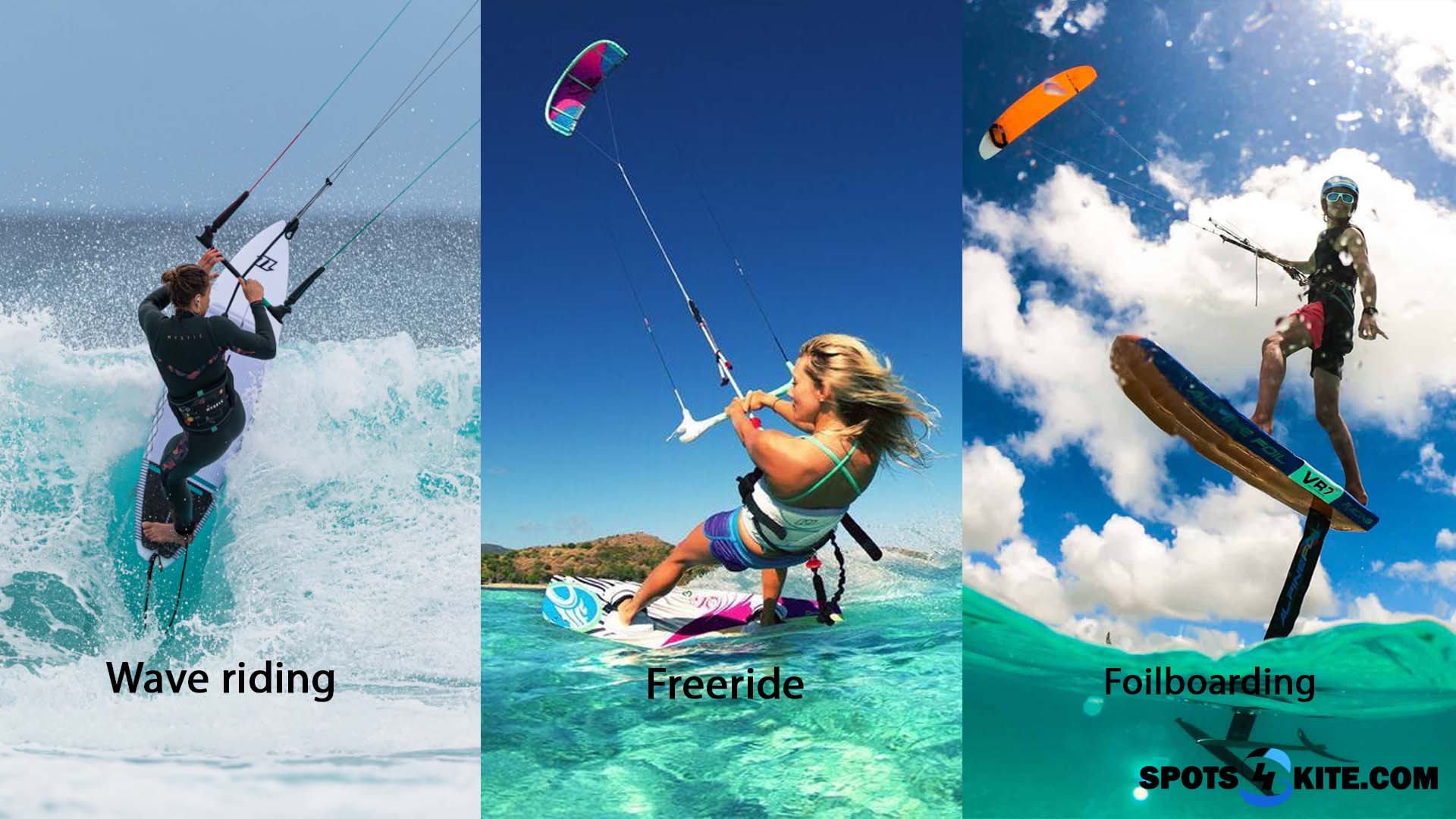
Freeride is the most common discipline and the first style of kitesurfing that everyone typically tries. It is essentially free riding, where riders use different wind and water conditions for fun, exploration, and improving their skills in this sport. Freeride is suitable for various conditions, from flat water to small waves.
Airstyle
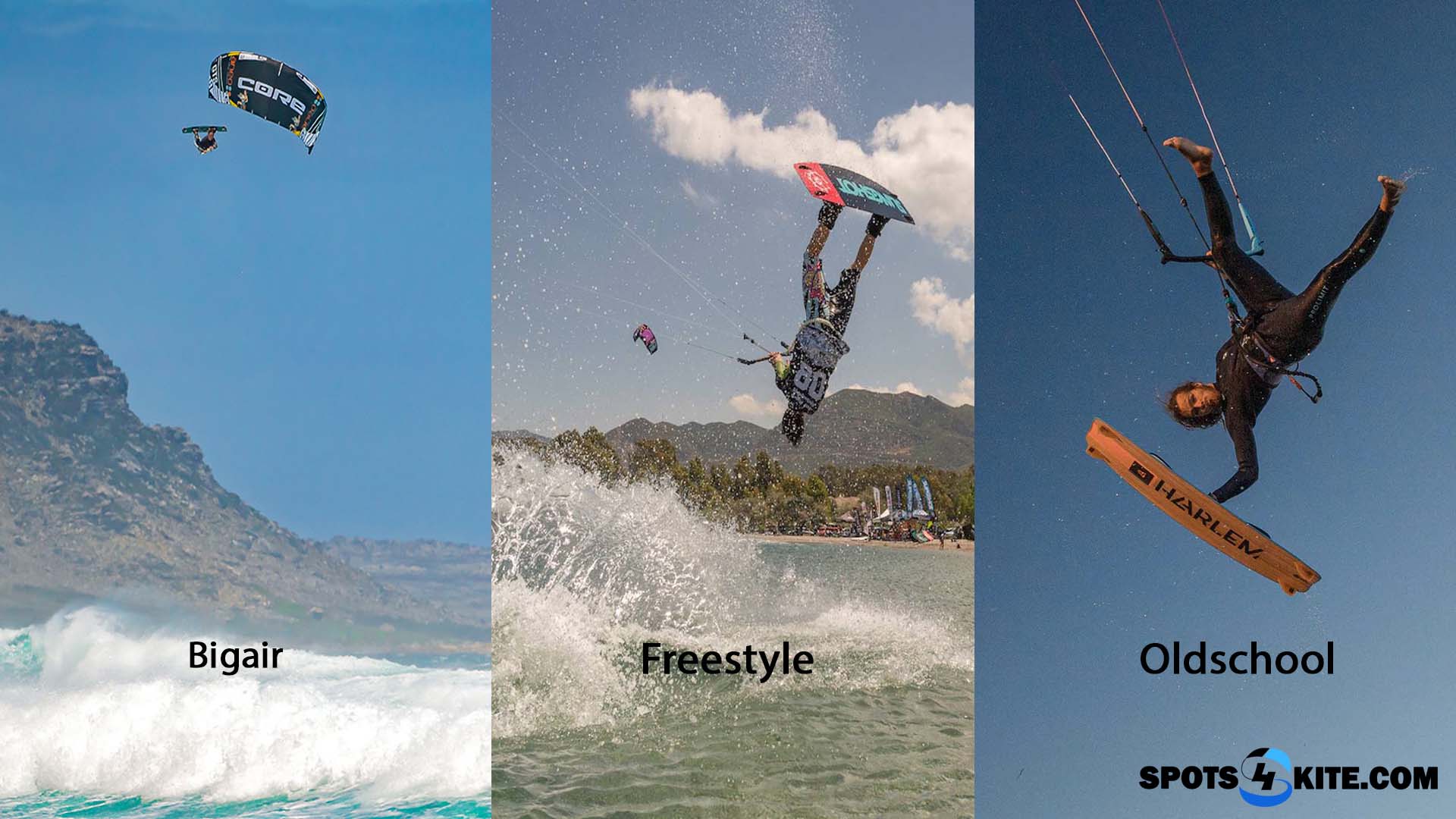
Airstyle, also called ‘Oldschool,’ involves bigger jumps with long hang time. Oldschool tricks such as board-offs, sliding, and flying are done while hooked in.
Freestyle
Freestyle focuses on jumps and performing tricks in the air without the help of external objects. Freestyle requires a strong dedication to learning new tricks and pushing your own limits. It includes tricks such as jumps, rotations, and can “unhook” from the harness allowing them to complete tricks, spins, and handle-passes. Boards with fixed bindings (boots), flat water, and pleasant wind are suitable for freestyle.
Wakestyle
Wakestale is a subcategory of freestyle where riders use kickers, ramps, and other artificial obstacles to perform tricks similar to those in wakeboarding.
Big Air
Big air is a discipline where riders jump as high as possible while performing tricks in the air. For high jumps, kitesurfers seek conditions with strong to extreme winds.
This discipline probably has the most competitions around the world. Judging at competitions focuses on the height of the jump and the execution of the tricks.
Wave riding
Wave riding is a specialized discipline utilizing waves, similar to surfing, but with the propulsion of a kite. Riding the waves requires a special type of surfboard, perfect kite control skills, and the ability to read the water and waves. Wave riding takes years to master.
Foilboarding
Foilboarding is a newer discipline that involves riding a board with a hydrofoil, which lifts the rider above the water surface into levitation. It requires good balance and control and allows for high speeds and long rides. You can practice foilboarding even in light wind and optimally on deep water.
Racing and Formula kite
Speed races, often using foil boards to achieve higher speeds. The combination of speed racing and foilboarding has created a completely new discipline called Formula Kite, which will be presented for the first time at the Olympic Games in Paris this year.

Author: Spots4Kite
The team behind Spots4Kite.
