
Monika on her Way to the Olympics

In the summer, we caught up with Monika at the Epirus Surf Center (Bouka) in Greece, where she had been training for a month in the Formula kite discipline for the 2024 Olympics. Having known her for some time and witnessing her dedication not just on the water but also on her bike, we felt compelled to interview her. We delved into the world of Monika Žižlavská, foil racing, the intricacies of various championships and races, and the qualification processes. We’ve tried to answer any questions you might have as well.
Enjoy the story of a doctor from the Czech Republic who wasn’t born near the sea, lacks financial backing from sponsors, doesn’t have a coaching background, yet is living her Olympic dream in one of the sailing disciplines.

Karel:
Hi, can you start by telling us a bit about yourself? What do you do and how did you get into foil kiting? And what drove you to aim for the Olympics?
Monika:
Actually, I decided to try racing in kiteboarding many years ago. I tried airstyle like Big Air or oldschool. But there started to be a problem; I was learning everything on foil kites and most of the competitions (to be fair) were on inflatable kites. And I admit, I didn’t do well with inflatables, or it was significantly harder for me. So occasionally, I tried some races in Egypt, but it wasn’t that great. Another problem arose when girls started doing unhooked moves. I didn’t like unhooking at all, it just doesn’t work for me, my mind won’t let me unhook. Back then, I thought, well, I’m getting old, I won’t race in kiteboarding anymore.
At that time, foiling began. Many of my friends started, and one of them told me: “Hey, Monika, try it, and you’ll be the first woman in the Czech Republic to ride on foil.” I declined for about 2 or 3 months, thinking it was nonsense, I couldn’t understand how someone could ride on such a thing. But then the idea kept haunting me. I thought it would be cool to be the first girl in the Czech Republic who can foil. So that’s how I got into foiling.
Karel:
And could you tell us a bit more about yourself, if you can introduce yourself to us?
Monika:
Yes, I’m 40 now. I used to work in a hospital as a doctor in the urology department. In fact, I practically led that department for the last two years before I resigned. After those two years in that high position, I was so drained that I decided I needed a break. I quit my job and started traveling. My boyfriend and I decided to take a year off from work, having worked for so long. We just worked, High school, college, and straight into a job. We just wanted some free time. And during that travel, I began foiling.
Then COVID hit, and during the pandemic, I decided not to return to my previous job. I kept my urology clinic for one day a week and decided to keep the other days free for sports. That’s when the idea of the Olympics came about. I wondered how to motivate myself to engage in sports when I would work only one day a week? How to find the motivation not to waste the rest of the days? That’s how the idea of preparing for the Olympics emerged.

Karel:
Was that in 2021? And the Olympics will be in 2024?
Monika:
Yes, it was in 2021.
Karel:
Did you think there was a chance initially, or was it just for fun?
Monika:
In 2021, when I started, I went to see the hydrofoil races at Traunsee. At that time, it was said that the Olympic race would be in pairs. There weren’t many pairs, mainly due to a lack of female participants. So there was a chance for me (in pairs). I had two young guys from the Czech Republic, but they could still compete in the junior category. I felt that being in a pair with them might hold them back, especially since one of them could be my son’s age.
But half a year later, it got resolved. New rules were set; categories were divided so that men and women competed separately.
At the beginning, I felt the chances were higher. Mainly, I didn’t think there were that many female competitors in the world. But as I started participating in races, I realized it wasn’t just 20 of us; it was 60. And some of those women are incredibly good.
In the Czech Republic, it seemed hydrofoil was just beginning and that I got on board at the right time. But as you start touring competitions, you realize that’s not the case. Everyone is already 10 years ahead, it just hadn’t reached us yet.
Moreover, most competitors, men or women, have access to the sea. They’ve been involved in yachting since childhood, which gives them a huge advantage. They can read the water, have wind experience, and know yachting rules (which we also follow). Their childhood experience is invaluable and a significant advantage for them.

Karel:
Can you describe for us how the races go, including the rules?
Monika:
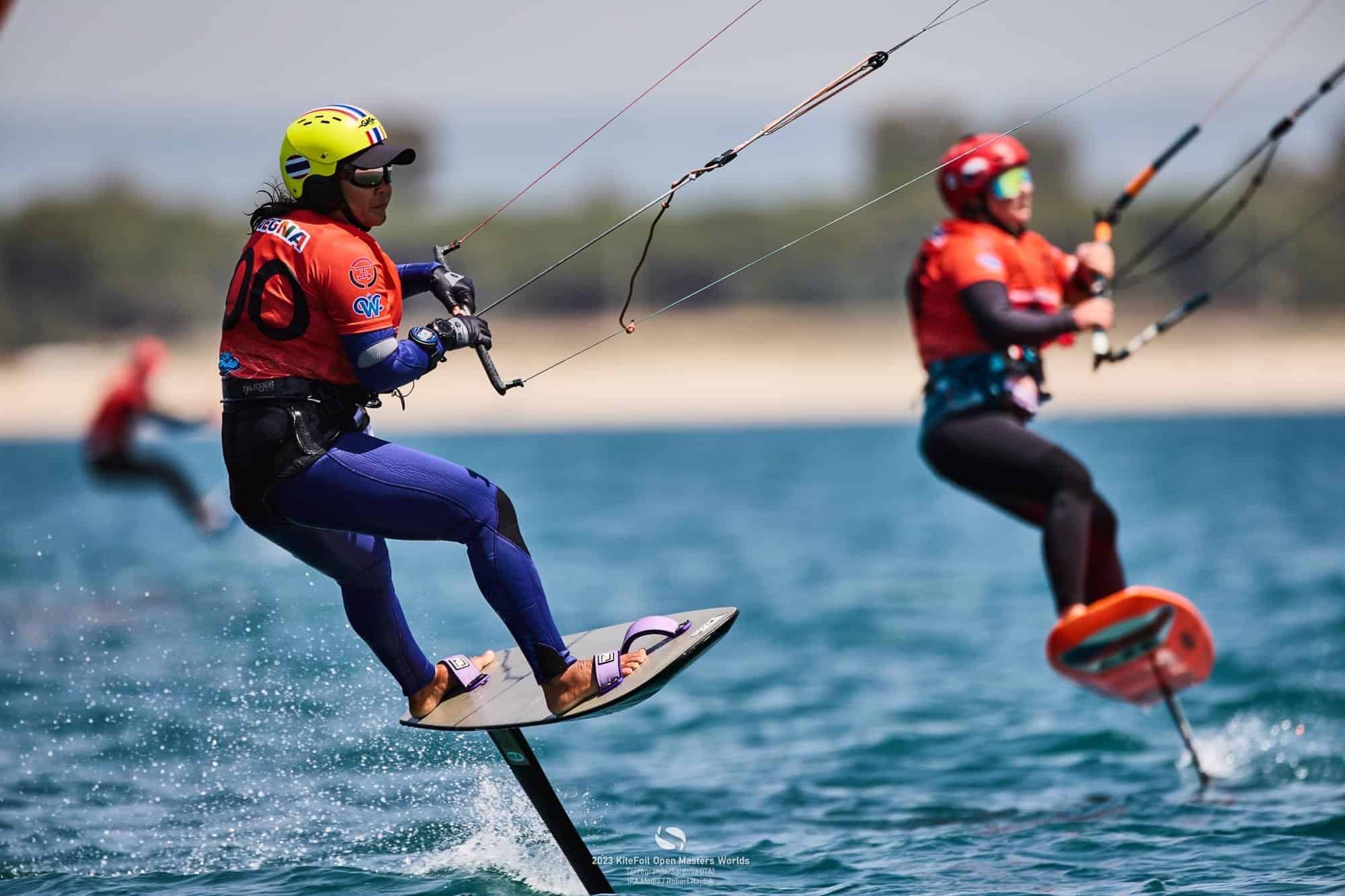
Formula kite races last several days and are essentially based on sailing rules. This means that ideally, during the race, one should complete 12-16 heats in the qualifiers. You score points in every heat, and the fewer points you get the better. Every fourth heat is dropped, so at least three heats are crucial and you should perform well in them. The worst one is always discarded. So, if you mess up once, it doesn’t mean you’ve lost the race. This is the same for windsurfers and sailors. This whole process is called the qualification series and all racers participate. Typically, on the last day of the race, the semi-finals are held with the top 10, and then only the top four race in the finals.
Races are usually structured so that you should complete four heats each day. Of course, sometimes the weather conditions aren’t ideal, so you might not get through all four and end up doing six the next day. However, you should never do more than six.
Karel:
Are the races categorized? Like World Championships, European Championships or are there any tours? Which of them count towards Olympic qualification?
Monika:
Currently, races are under Worldsailing, IKA, and the World Kite Series, so three institutions. Worldsailing tries to cooperate with IKA, and these races are ranked and are considered for the world ranking. They have a higher registration fee, and you can only use equipment certified for the Olympics in these races. These institutions also organize the World and European Championships.
Then there are the World Series races, which are Open. They have their ranking, but you don’t earn points towards the Worldsailing qualification or world ranking. These races are a bit cheaper, and since they are Open, you can use non-certified equipment. But 90% of the racers still use certified gear, considering it as a practice race.
The World Series races are usually in friendlier locations, while the IKA and Worldsailing races are often in less kite-friendly places, often combined with windsurfing and sailing events. This means they look for places with harbors, ideal for sailors and windsurfers, which might not be ideal for kiters. We often end up racing offshore or in gusty winds in front of hotels.
Regarding Olympic qualification? For us Europeans, there are three races that we can qualify from: the World Championship in Haag, the European Championship in UK, and the so-called “Last Chance” regatta next April in France.
Overall, there are about 12 spots for European countries and 8 spots for other continents. But when you qualify, you’re doing it for your country, not yourself. Then the Olympic Committee decides which racer goes to the Olympics. In the Czech Republic, we currently have three girls.
Karel:
I believe that countries like Spain or France must have tough competition.
Monika:
The French have at least 10 top female racers, but only one can compete. Each country can have only one spot, so it’s a fierce competition. Spain doesn’t have as many racers, but for countries like France or Italy, it’s very competitive.
Karel:
You mentioned about 60 racers in the starting field. How many of them are from Europe and the rest of the world?
Monika:
80% are Europeans, with many from France, Italy, and also England.
Karel:
What about America or Brazil?
Monika:
America basically has only two girls. One of them has a family, so she doesn’t race much, maybe only the World Championship. From America, it’s mainly Daniela Moroz. Canada is growing; initially, they had two Canadian girls, now about five.
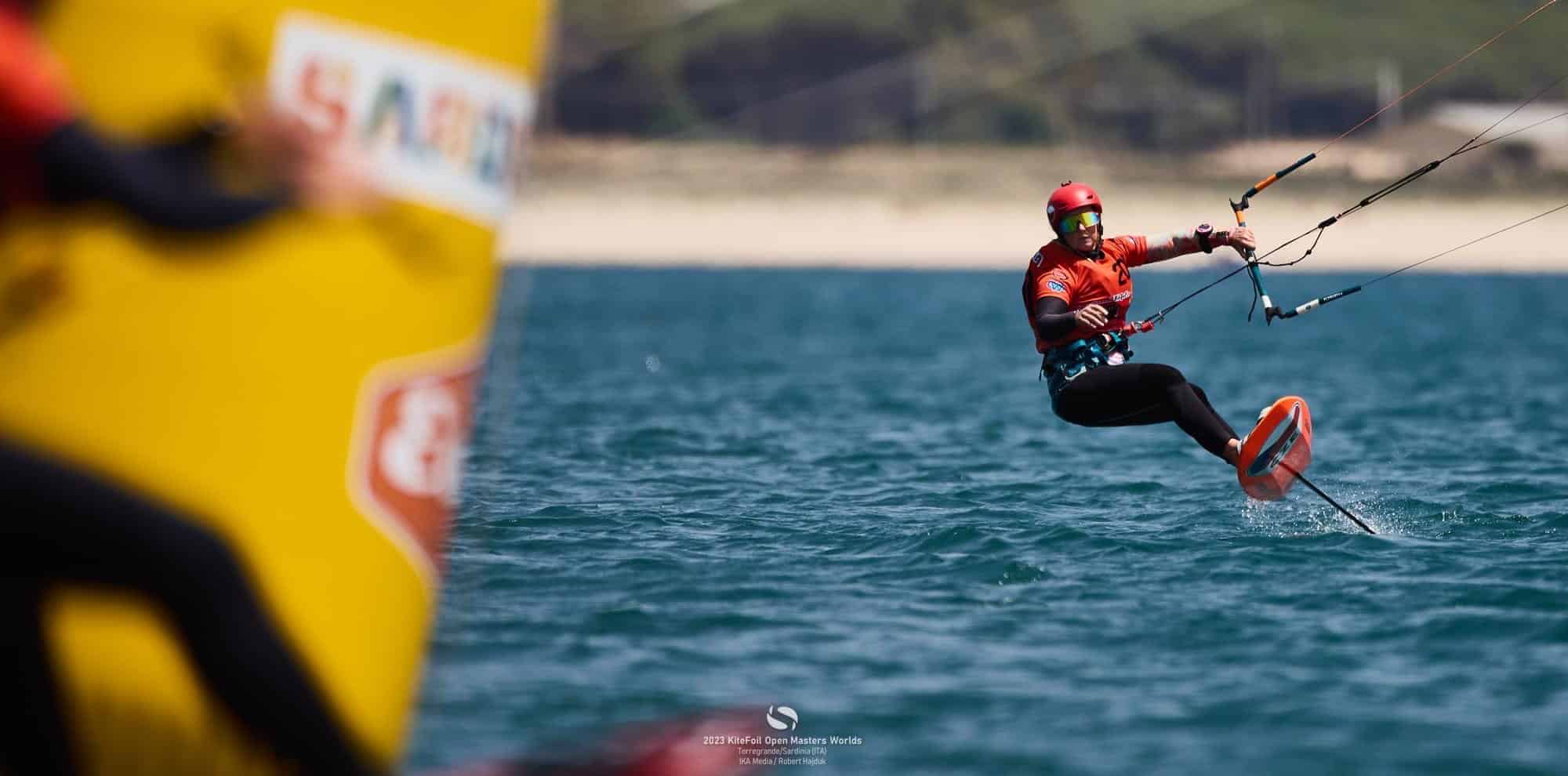
Countries like Brazil, Venezuela, Colombia, and Thailand participate, but usually with just one girl each.
Karel:
Are the races mainly in Europe or worldwide?
Monika:
Worldwide, but a significant percentage of the races are held in Europe.
Karel:
Wouldn’t it be easier for you to race outside of Europe? Because then you’d face fewer European competitors?
Monika:
Yes, but those races don’t offer qualifying spots for Europe. So, if I went to the Asian Championship, even if I won, I wouldn’t earn a spot at the Olympics because someone from Asia must qualify from that race. They will have it open, so technically I could be, exaggerating a bit, the Asian champion, but they would exclude Europeans from the qualification ranking.
Karel:
And how do you assess your abilities, equipment or opportunities versus other competitors? What chances do you give yourself for the Olympic nomination? How many girls are there, say, really at the highest and pro level? And how many like you, who try to train in some way while working?
Monika:
Well, tough question. It seems to me that a lot has changed in the past year. And most of these girls started taking it very seriously. For example, at the World Championship, there should be about 60 of us, and I think 20 to 30 girls are really just doing sports, training, and have sponsors (or wealthy parents). And maybe 2 or 3 English girls, who are at the very top, are paid by their association and have kiting as their job. The French and Italian girls also have it as a job. Many girls from countries where there is usually only one, they don’t get full support from the association to have it as a job, but they usually have sponsors and can fully commit to it. And of course, there are girls who study, so the parents finance it. But school usually doesn’t limit them in training and competing.
Karel:
So you’re saying you’re one of the few exceptions there?
Monika:
Well, maybe there are around 10 of us, like me, who try to train, compete, but also work and finance everything ourselves.
Karel:
How much does one trip to the races cost you?
Monika:
I usually try to plan the trip to the races so it costs me as little as possible. I always have to count that the registration fee is 300-500 EUR. If possible, we travel by camper, ideally free camping, so we don’t have to pay for a campsite. We usually cover about 2000 km, so even the travel cost is around 800 EUR. We try to ensure that one race trip costs up to 2,000 EUR. Sometimes it’s less, sometimes slightly more, which is why I don’t attend all races like most of the girls. I usually choose the most accessible and most important ones. Unfortunately, these are the races where there are many of us, and I don’t finish well. I could choose less effective races with fewer participants and be happy to finish, say, in the top ten. But I always tell myself, look, these are not the races that are important to me, maybe for a World Championship nomination. It would be great to finish in the top ten or twenty (because there are weaker riders there). It would be a great feeling, but then I count whether it would be more wasted money, you know.
Karel:
And can all of this be financed from your current job?
Monika:
So far, I can afford it in the sense that I can go to the races I choose and buy some equipment. As I’ve been buying it gradually over 2 to 3 years, it’s manageable. Of course, I also have some friendly discounts, but so far, no one has been willing to give me a kite for free. Ideally, I would like to have more equipment, so I have separate sets for training and racing.
Karel:
I noticed you ride both Flysurfer and Ozone?
Monika:
Last year, I flirted a bit with the Ozone because of its price. To be honest, I got a better deal there and knew I needed to update my gear. At that time, the Ozone was also more available because you had to wait six months for new Flysurfer kites. But I found out that the Ozone doesn’t suit me in large sizes. That’s why I now have such a mix. Small sizes, nine, eleven, are Ozone because they are more pleasant, friendlier kites, not so sharp. And the Flysurfer kites, fifteen and eighteen, they suit me for larger sizes.

Karel:
So you have four kites?
Monika:
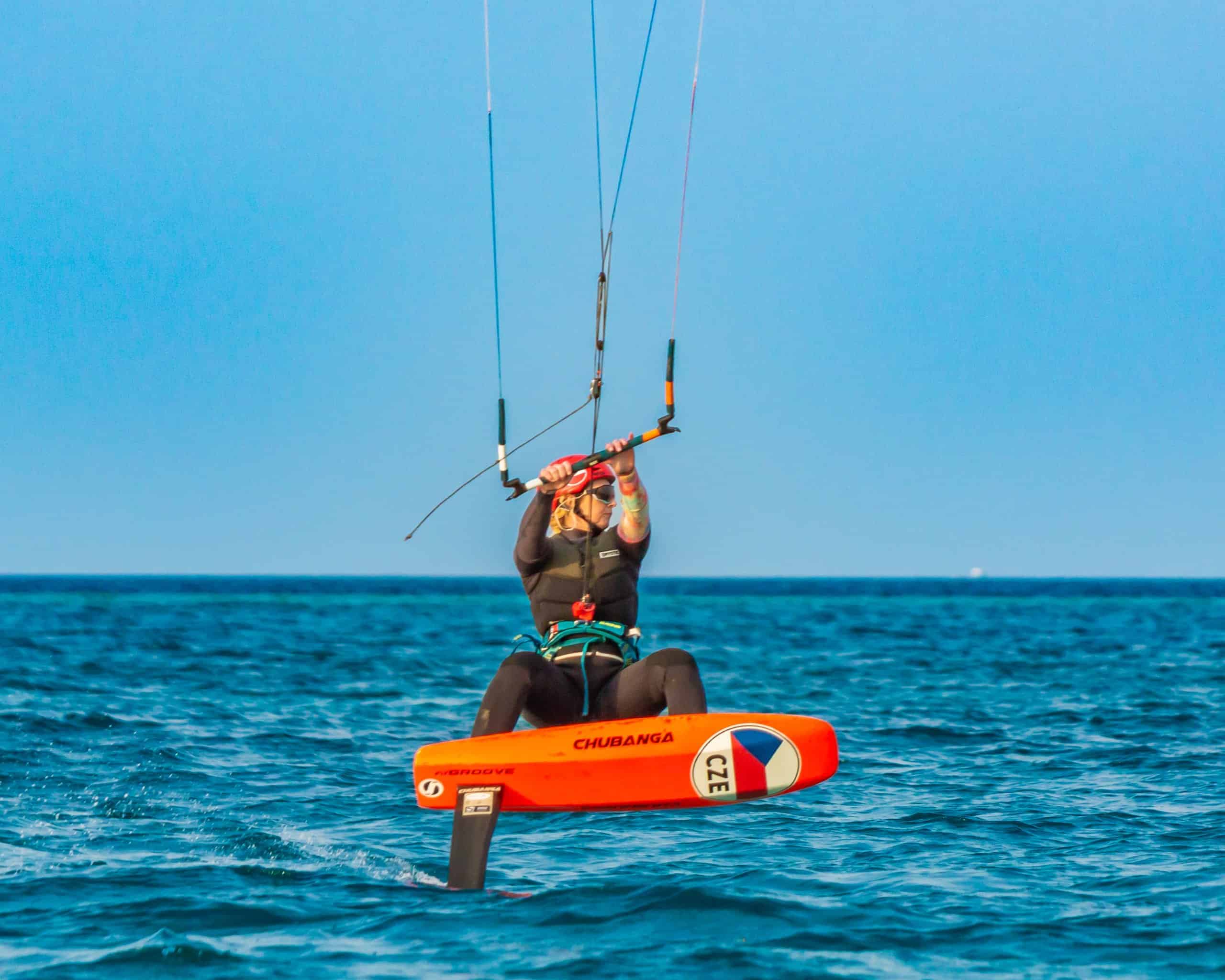
Yes, four kites. In fact, for a race, you can register four kites and one board. And I have two foils now.
Karel:
So, just out of curiosity, how much is your equipment worth?
Monika:
I think it’s over 20,000 EUR. For a long time, I had a second-hand board and foil. Only last year did I save up and bought a new board and a new foil, and this set alone cost me 4,500 EUR. Then I found out that the old board wasn’t suitable for me, so I sold it for a ridiculous price, and in fact, I have one board, but two foils.

Karel:
And back to you, the races, and what chances do you give yourself for the Olympics? We’ve noticed you had a decent placement recently.
Monika:
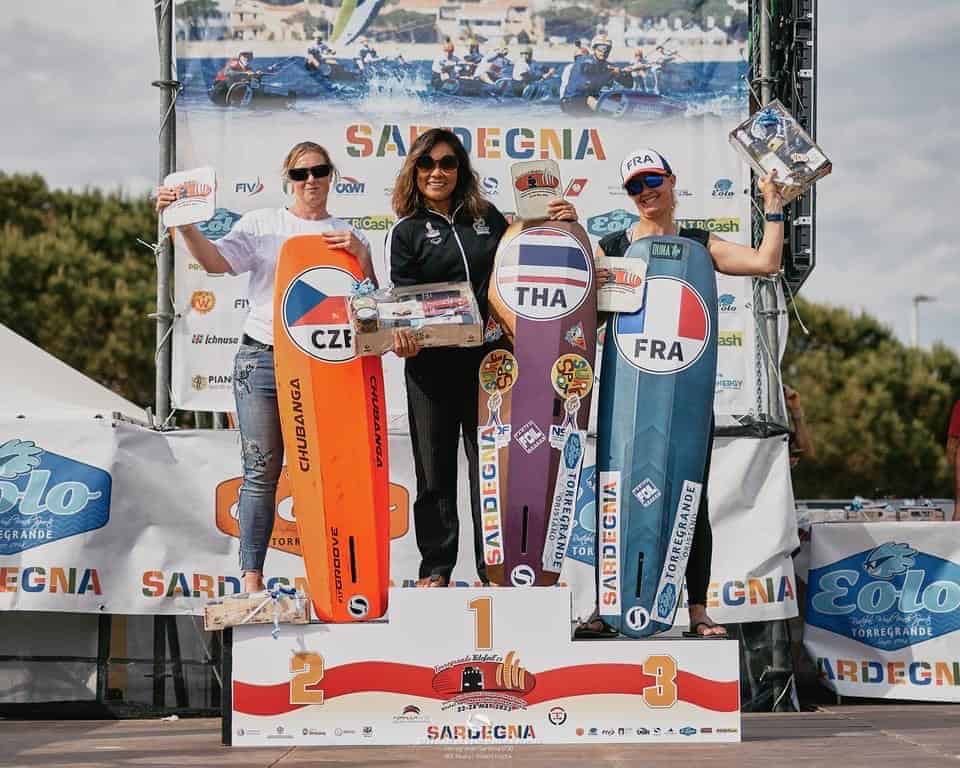
I was second in Sardinia at the World Championship for those over 35 years old. This time, for the first time, it was separated, so only competitors over 35 raced.
Karel:
And what about your chances of getting to the Olympics?
Monika:
I think that this year the chance to qualify from the world championships or the European championships is not there for me. I have to wait for the Last chance regatta, which will be held next year in April in France. It could be favorable for me there because it will be the third time I’ve been to that location. We’ve raced there twice before, so you could say I’m familiar with the place. The last five qualification spots will be awarded there, and I believe about 6 to 9 girls will be competing for them.
Karel:
So, it’s like fifty-fifty?
Monika:
Well, maybe a bit less than fifty-fifty, but there’s a chance. Because the strongest countries will already have secured their qualification spots, leaving the last three for us, the ones I call the “residue”.
Karel:
And why do you think you can’t, or don’t stand a chance to qualify earlier?
Monika:
I think a major factor is that I don’t have a coach. I’m basically self-taught. It’s not that I wouldn’t want one, but I just don’t have the money for a coach. Plus, the good coaches are already taken and paid for. So, it’s hard to find a coach, and even if I found one, I’d need to have enough money to pay for him to focus solely on me. It’s really hard during races when you’re exhausted. After 2 to 3 hours on the water, you’re tired, constantly going back and forth. The girls who have coaches also have their coaching boats. They actually, after each race, go to that boat, sit down, relax their legs a bit, get something to drink, eat. I always have a snack bar or an energy gel in my wetsuit, but I manage all of this while on the go. It may not seem like much, but every five minutes you give your legs a break can make a huge difference in the next race.
Karel:
And when you compare your abilities and times with other racers?
Monika:
I’d say I’m in the middle of the starting field, maybe slightly behind the middle.
Karel:
So given your financial situation and lack of coach support, that’s good.
Monika:
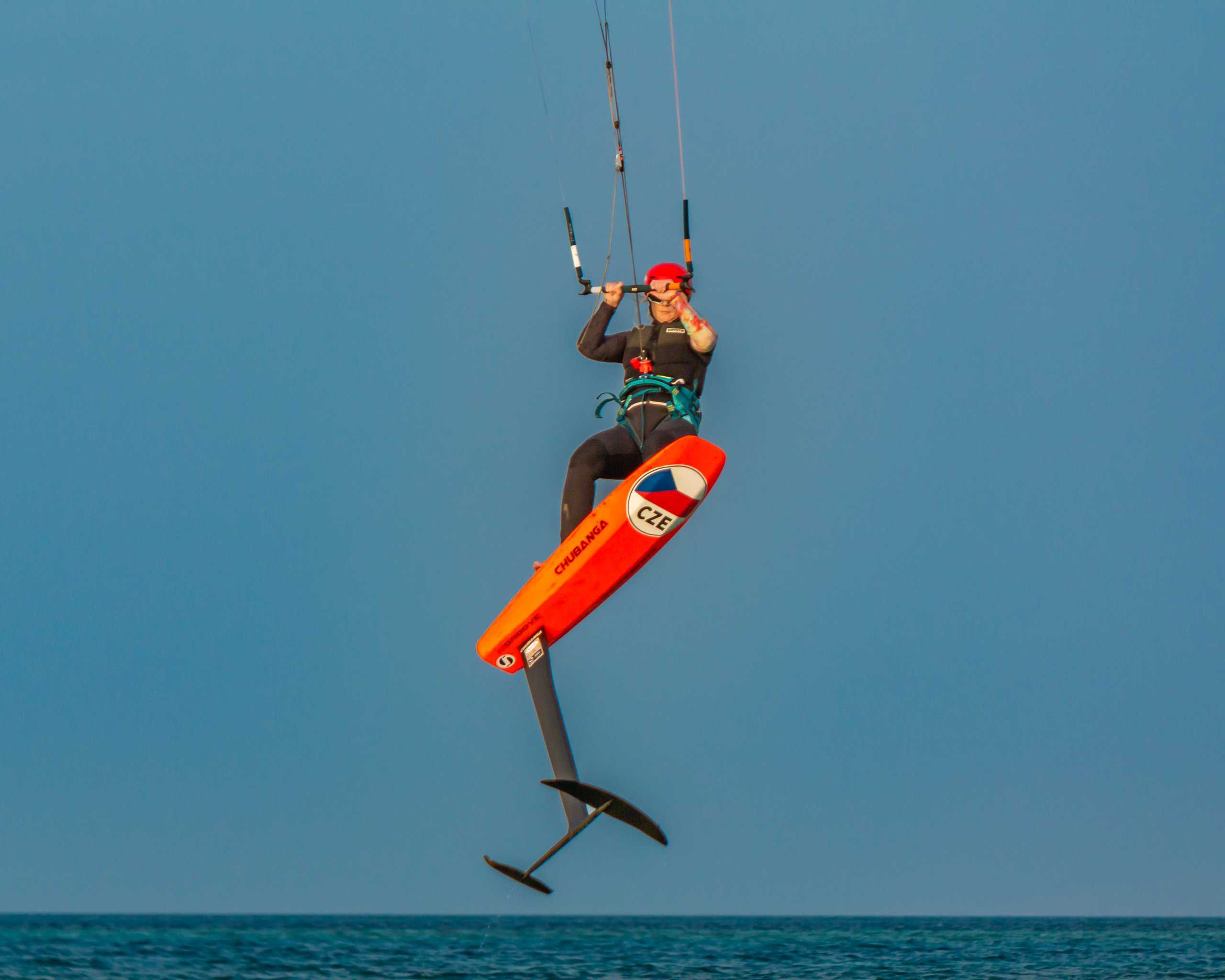
Considering I don’t have a yachting background from childhood, and I lack support on the water and am still learning the rules as I go, I think I’m doing pretty well. One might feel they’re lagging, but looking at the progress I’ve made in two years, with my own efforts and without any help or support, I can confidently say I’ve achieved something noteworthy. It’s a tough journey when you don’t have experience to draw from.
Karel:
Do you think you currently have opportunities to catch up and improve on your own?
Monika:
I believe that now, in order to catch up and improve, it’s crucial for me to ride with someone.
Doing it on my own just isn’t enough anymore. For instance, here I’ve set up a track for myself, monitoring my rides on a watch, and I see my average speed improving, which is great, and I can work with that. But I don’t have a comparison to know if I’m doing something wrong or taking the wrong angle. You really need to see it in the moment and in those specific conditions to compare. Looking back at it, it’s hard to decipher. You’d look at it and think, “I should have taken that angle this way.” Of course, there are apps or devices that can evaluate it. But you’re always dealing with the fact that every day there are different waves, or there might be a sudden gust, the conditions are not constant, it’s not a track in a closed space. So I think the only way to truly compare yourself with someone is to ride alongside them and see what’s possible and what’s not.
Karel:
Where do the other girls train? Why are you here and not with them?
Monika:
Actually, finances played a role this year. Over the winter, most competitors spent 2 to 3 months in Fuerteventura training, so they often rode together. But for me, it was simply too expensive. When I looked at the flights, accommodation, and everything, I realized that the amount I’d spend on 14 days of training in Fuerteventura would allow me almost two months of training in Egypt. However, I’d be alone there. It’s a trade-off. Back in winter, I assessed the situation and felt I had a lot of things to improve on, which I could work on by myself. But now, I really feel I need someone alongside me.
That’s why I’m trying to secure more funding and find a coach. Either I’ll just take the coach if, based on their experience, they say we can still train alone. Or they might suggest we can’t train on our own anymore and need other competitors around.
Most of this summer, everyone is training in Marseilles, where the Olympics are to be held next year. However, the conditions in Marseilles are such that without a boat and a coach, you’re left stranded. A lot of the times, people ride offshore there. So, besides the fact it would be incredibly expensive for me (accommodation and all related expenses), there’s also a risk that out of 14 days, I’d only be able to ride three days when the wind is right. The rest of the days, I’d be sadly watching the others depart on boats, as very often the start is from a boat, with coaches taking competitors to the right wind spots.
So, I find myself in the situation again where I’m here (in Greece) alone for a month. I know it’s for significantly less money, I ride alone, but I know I’m riding every day. In practice, I get more training here than I would have in Marseilles. Again, it’s a trade-off.
Karel:
What about the risks or chances of getting injured in this sport?
Monika:
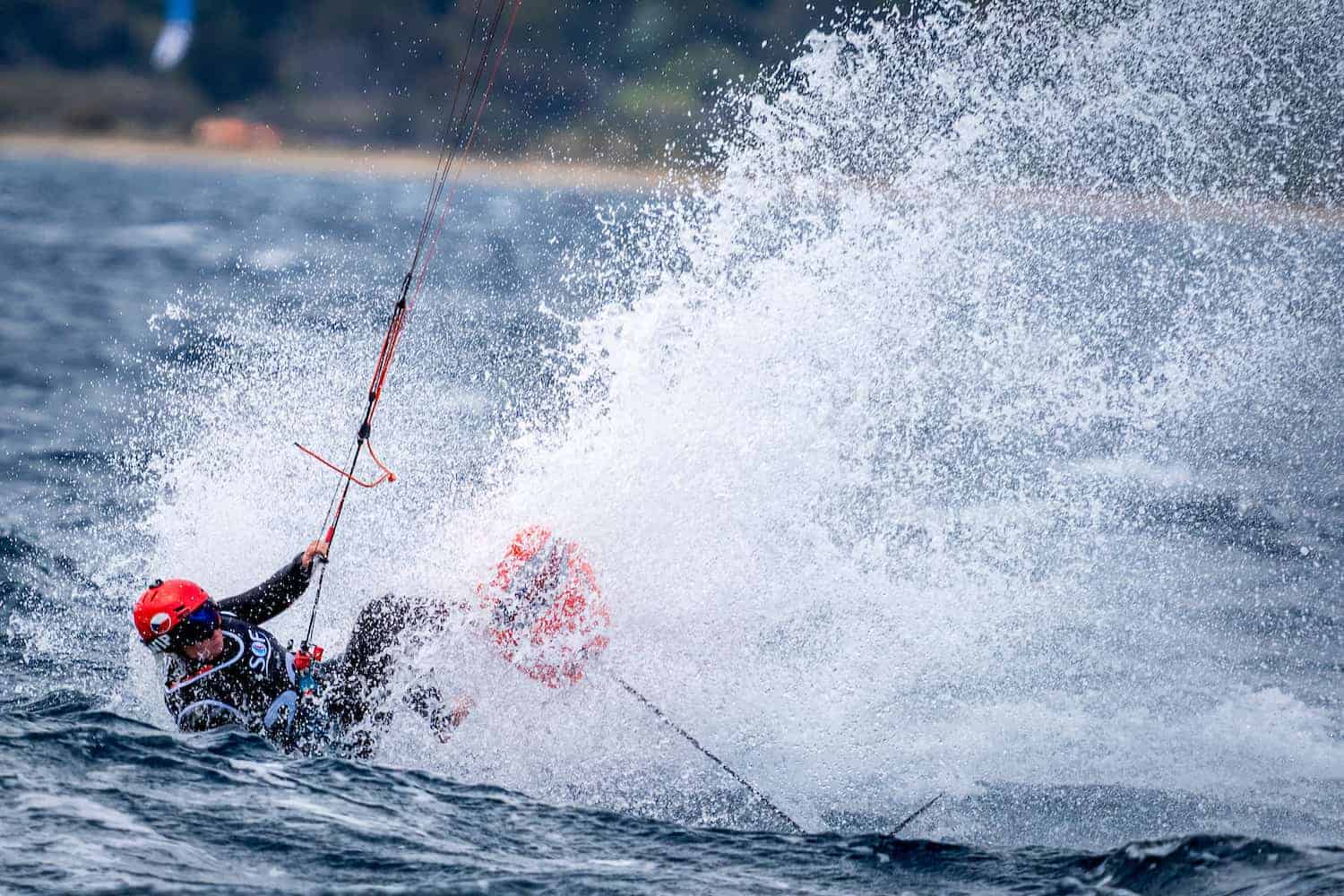
Of course, one tries to do everything to prevent injuries, but it’s dangerous during races, especially with 25-35 of us racing at once. For us girls, it’s still manageable as our starting field is varied, meaning there’s a mix of fast and slow racers. The biggest scramble is at the start, but some of us, including me, are more cautious. We know it doesn’t make sense to fight among the top 10 when they are racing at an entirely different level. So, in a way, we start behind them.
Karel:
Is it common for, let’s say, you to get tangled up or even cut the lines?
Monika:
It often happens with those rushes at the start. Racers often don’t give way to each other, leading to collisions. And then at the buoys, there are a lot of collisions. Everyone converges at the buoys, so there are often tangles there. Well, it can get ugly there, especially when the girls are tired and there’s gusty wind. So a girl, caught off-guard by a gust, can’t control it and crashes into the one in front of her. Sometimes they are thrown in the air. But I must say, I’ve seen many ugly situations, but fortunately, they didn’t result in ugly injuries. Maybe equipment got damaged, but mostly, thankfully, the racer wasn’t seriously hurt.
But it’s also because we usually race in wetsuits. Even if it’s warm, I, for example, wear a full wetsuit for races. In case something happens, so I’m not too banged up, plus of course a vest and helmet, you can’t go without it. We usually also wear glasses, not because of the sun but similar to ski goggles, to protect our eyes in case the foil flies towards the face.
Karel:
Is it really, as they say, elbow to elbow? Because, after all, if someone pushes you, you’re off, right?
Monika:
At the start and at the buoys, there are those rushes, but again it’s more common among the boys than the girls. Mostly, it’s not intentional, more like avoiding one and bumping into another. On the start, there’s usually a push when approaching the start and going relatively slowly, so you wobble and usually manage to keep your balance. But then, of course, when it’s elbow to elbow at speed, people fly through the air and snap the lines.
Karel:
And let’s get back to the Olympics one last time. How do you perceive all of this? You have a chance to qualify for the Czech Republic, but at the same time, you might not be nominated for the actual Olympic race. Would you be very disappointed if you weren’t at the Olympics?
Monika:
If I didn’t qualify, if things didn’t work out, I would probably be sad, but it wouldn’t be the end of the world for me or a disappointment. Rather the opposite, if I did qualify, I would be pleasantly surprised. I see it realistically. And if I did qualify, and the association didn’t send me and chose someone else instead, it’s true that I would probably lose trust in that institution, probably for good.
Karel:
Do you have any indication of how the association might approach it?
Monika:
Basically, the general sentiment is that they think we won’t qualify. They practically don’t discuss it with us, they don’t believe in us. It’s not that they’re hindering us, but we also don’t have any support. I naively think that if I qualified, there would hopefully be some support. I also think there’s a chance we might find a coach, perhaps from the athletes who don’t qualify.
Karel:
So, what’s after the Olympics?
Monika:
I don’t know, maybe I’ll have to go back to work (laughs), but I was really lucky with my boss. I had freedom, but at the same time, my last working year was quite demanding. The boss has also left the hospital department, and I fear that under a different boss, I might not be able to do the job. Or I might need to expand my own clinic. At the same time, I know I miss performing surgeries. So I’m constantly speculating about what will happen.
Karel:
Yes, but once you get a taste of kiting and traveling, it’s hard to leave this lifestyle, right?
Monika:
Yes, that’s exactly it. When I left the hospital, I said I’d take a year off, and that year turned into three years. And it keeps extending. On the other hand, I think, do I need to earn money to have a great car and a house with a pool? Or is it enough to earn just enough to finance my hobby and enjoy life? I felt this way for a long time, more than 10 years. Until I started feeling like, great, another paycheck, but what am I going to spend it on?
Karel:
And one more private question, how does your family feel about all this?
Monika:
I think my dad and other relatives accept it in a way, but in another way, I’m kind of the black sheep. Because I often miss family celebrations, sometimes a relative has a milestone birthday, and I can’t attend because I’m racing. They’ve sort of come to accept it, they’ve gotten used to it, but sometimes they resent me and my boyfriend for being a bit different.
Karel:
Thank you for your time and in conclusion, we wish you luck in the upcoming races. And we’ll keep our fingers crossed for you to make it to the Olympics, so we can watch you on TV.
Facebook: @czemz2
Instagram: @monifs7

Author: Karel
I simply love kitesurfing :-).
