
Kitesurfing Glossary: A Comprehensive Guide to Essential Kitesurfing Gear

Kitesurfing is an exceptional sport, but it can often be confusing with its unique terminology and equipment. Learn the differences in kiteboards, types of kites, and essential gear to get started. Dive into our guide and demystify kitesurfing today!
Kitesurfing, also known as kiteboarding, is a water sport where you harness the power of a maneuverable traction kite propelled by the wind. Kitesurfing combines elements from various board sports like surfing, wakeboarding, and snowboarding. Kitesurfers use a specially designed kite, which is attached to the rider through a harness, allowing them to use wind power to glide across the water on a board.
Kiting can be practiced in various water conditions, from calm flat lakes to stormy ocean winds, making it a versatile water sport that can be enjoyed by people at all skill levels.
What is the difference between kitesurfing and kiteboarding?
Generally, the terms kitesurfing and kiteboarding are used interchangeably to describe the same sport. However, on a technical level, these two terms may refer to different styles of riding. Kitesurfing specifically refers to a style that includes riding on waves using a special surfboard. Kiteboarding, on the other hand, more generally refers to riding with a kite on any type of board.
The term kiting is also commonly used. Kiting can be practiced with a snowboard in the winter on snow, hence the term snowkiting, or on a special wheeled board on flat ground, known as landkiting.
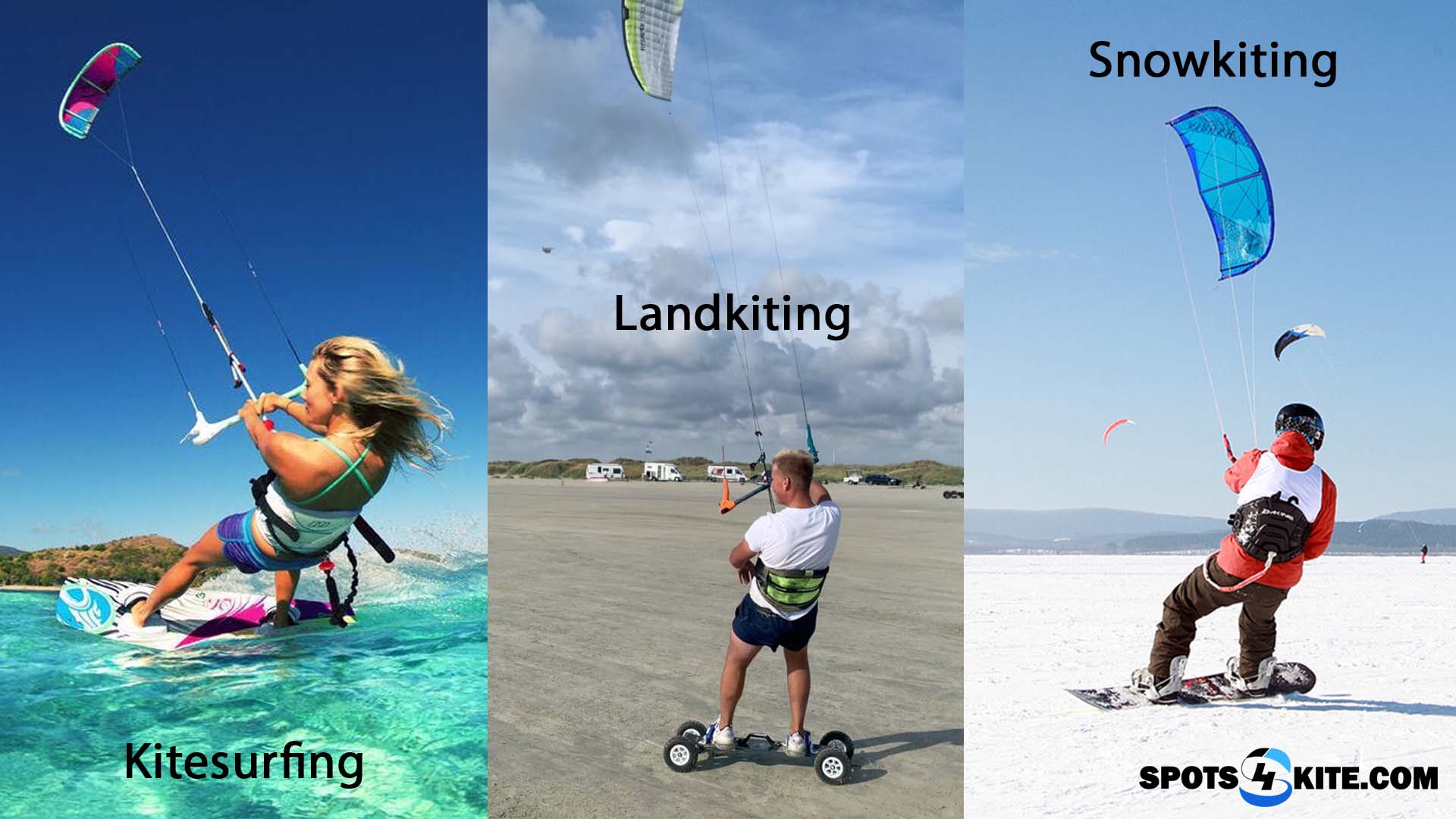
If you want to learn to kitesurf or simply seek explanations of various terms related to kitesurfing, you are in the right place. In this beginner’s kitesurfing glossary, you will find everything you need to know.
In this article, we most commonly use the term kitesurfing as a general discipline, referring to riding with a kite and board on water.
Basic equipment needed for kitesurfing
Kitesurfing requires specific equipment to ensure safety and fun under various wind conditions and surfaces on which the kiter rides. It is important to choose equipment that is suitable for your level of experience and the conditions in which you will be riding.
- Kite: The kite used to propel the kiter over water (snow, land).
- Board: The board on which the kiter stands and rides. It can come in various shapes and sizes depending on the style of riding or the surface.
- Bar: The control bar that is attached to the lines and allows the kiter to control the kite.
- Lines: Lines that connect the bar to the kite. They help transfer the force from the kite to the kiter and are also crucial for control.
- Harness: A harness worn by the kiter to which the bar with lines is attached.
Kite
The primary tool for propelling a kitesurfer on water, snow, or land. The kite is typically made from lightweight materials such as nylon or polyester and is attached to the rider’s harness through lines and a control bar. Kites are a much-discussed and carefully chosen piece of equipment among kitesurfers. The basic parameters of kites include type, shape, and size.
Types of Kites
Leading Edge Inflatable (LEI) Kites
Inflatable kites, also known as LEI kites, consist of a single layer of canopy that is attached to an inflatable structure. The leading edge, which faces into the wind, is formed by a thick inflatable tube known as the bladder.
Thinner inflatable struts extend from the bladder to the trailing edge, which are essential for maintaining the kite’s shape. Kites can have a varying number of struts depending on the size of the kite. Medium-sized kites have 5 struts, smaller kites have 3, and a new development kites, which have only a single central strut (mainly for kite foiling), making them very lightweight.
The inflatable structure of the kite ensures it retains the correct shape and characteristics necessary for optimal performance. The bladder must be inflated to the pressure recommended by the manufacturer, requiring a special pump that is considered basic equipment for LEI kites.
Inflatable kites are the most common for water use and are recommended for beginners due to their ease of control, stability, and their forgiving nature when mistakes are made.

Foil Kites
Foil kites are constructed from two layers of fabric connected by internal ribs that extend from the leading edge to the trailing edge of the kite. These kites automatically fill with air upon launching, eliminating the need for a pump. The internal cells filled with air help maintain the kite’s shape.
Foil kites may have either open or closed cells along their leading edge that allow air to enter and inflate the kite. They are supported by multiple bridles that help maintain the structure of the double-layered canopy.
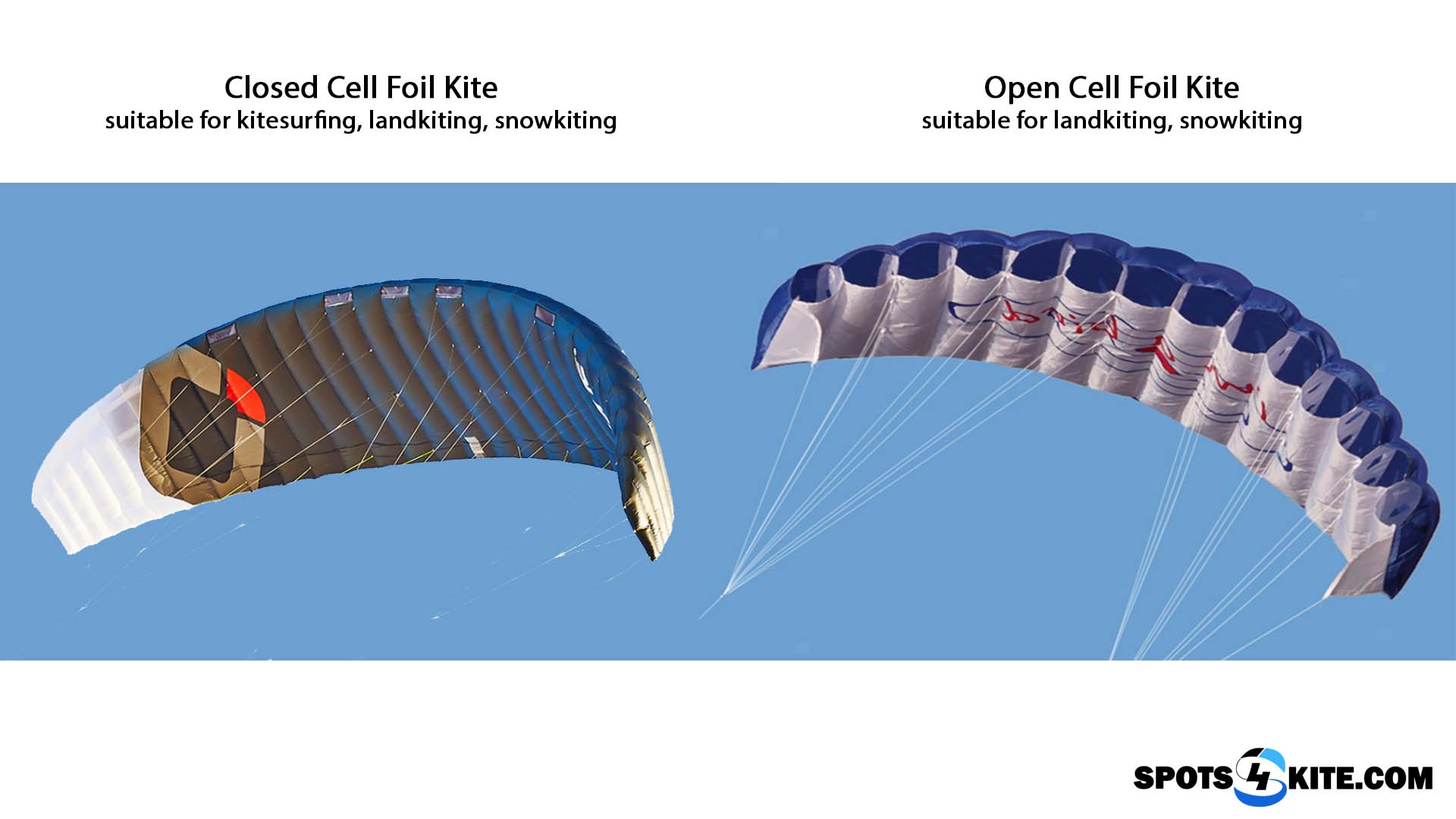
The shape of foil kites is also maintained by a complex network of lines, similar to those used in paragliding gliders.
Lighter and able to generate more power than inflatable kites, foil kites are recommended for lighter wind conditions. They are popular among experienced riders, speed racers, hydrofoil enthusiasts, and fans of snow and land kiting due to their performance advantages and versatility in various environments.
Basic Shapes of Kites
C-Shape Kites
C-kites, also known as classic kites, are the original style of inflatable kites characterized by their C-shaped arc. These kites offer a direct and responsive feel, making them favored by riders who seek precise control. The distinctive feature of C-kites is the absence of bridles supporting the leading edge; instead, lines are attached directly to the four corners of the kite. These kites are mostly used for freestyle and are not very common recently.
Bow Kites
Bow kites are inflatable kites featuring a bridle on the leading edge. They are distinguished by their flat, swept-back profile and a concave trailing edge, which allows significant depowering capabilities. The flat profile with bridles tapers towards the back, enhancing the kite’s ability to depower. The inclusion of bridles and pulleys extends the power range and facilitates easier relaunching. Additionally, bow kites provide a softer and more indirect feel when riding, although they are more susceptible to inverting under certain conditions.
Hybrid Kites
Hybrid kites combine elements of C-kites and bow kites, utilizing bridles to support the leading edge similar to bow kites. This configuration allows for a variety of arc shapes, providing versatility in performance. A key distinction of hybrid kites is their convex trailing edge, contrasting with the concave trailing edge found in bow kites.
Delta Kites
Delta kites refine the hybrid design with a more triangular shape when flattened, increasing the “projected area” facing the wind. This design boosts power output, making delta kites effective in a range of conditions. Like other modern designs, delta kites incorporate a bridle system.
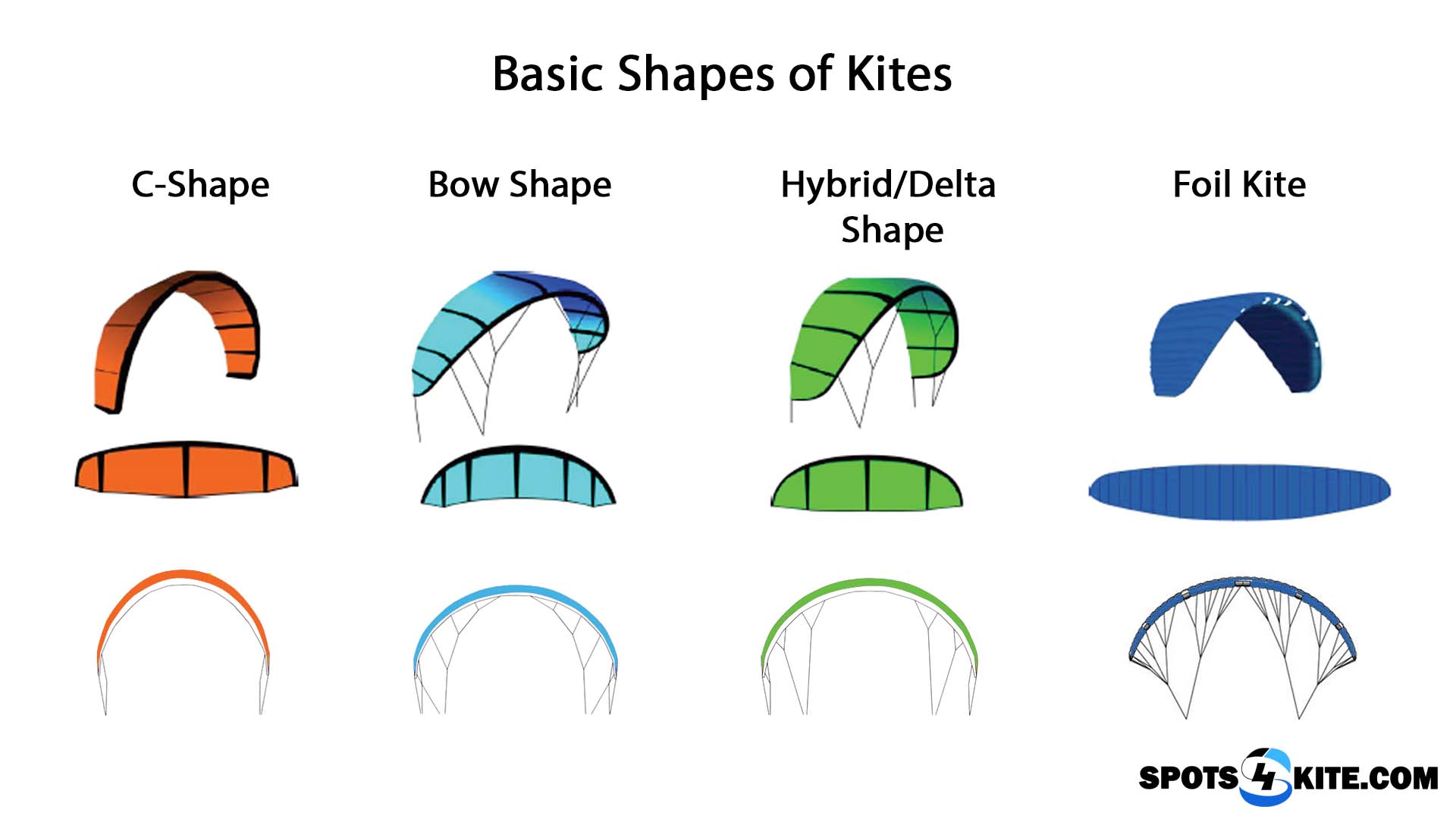
The best kite shape depends on individual preferences and experience levels, but hybrids or bow kites are generally recommended for beginners and recreational kitesurfers. C-kites remain a niche choice mainly among hardcore freestyle enthusiasts.
Kite Sizes
Kite sizes are typically measured in square meters (m²), indicating the surface area of the kite that catches the wind. The size of the kite can often be identified from a distance by the number on the canopy, which represents the size in square meters.
The size of the kite is a crucial factor to consider based on your skill level, body weight, local wind conditions, and preferred riding style. The general rule is: the stronger the wind, the smaller the kite needed; conversely, in lighter winds, a larger kite is necessary to achieve the required power and performance.
For beginners, it is advisable to have at least two kites with a maximum size difference of 3-4 m². Below is a sample sizing chart:
- Rider 90 – 100kg: 13-14 + 9-10m²
- Rider 80 – 90kg: 12-13 + 8-9m²
- Rider 70 – 80kg: 12 + 8m²
- Rider 60 – 70kg: 11-12 + 7-8m²
- Rider 50 – 60kg: 11 + 7m²
Another factor to consider when choosing the right kite size is the type and size of the board. For example, surfboards used for wave riding have greater buoyancy and therefore pair well with smaller kites. Similarly, for riding with a hydrofoil, which has minimal drag, smaller kite sizes are suitable.
Most manufacturers produce their kites in various sizes, allowing kiters to select an appropriate kite based on their physique, weather conditions, and skill level.
Kiteboards
A kiteboard is the platform on which a kiter stands while being pulled by the kite across the water. Selecting the right kiteboard is as crucial as choosing the appropriate kite, with the rider’s weight, the type of kitesurfing, and the style of riding playing significant roles in this choice. There are several types of boards available, each suited to different riding styles and conditions.

Twintip Boards
The twintip board is the most common type of kiteboard and features a symmetrical shape with fins at both ends, designed for riding in either direction. This versatility and the board’s inherent stability and control make it the preferred choice for all-around riding and various conditions, making it ideal for beginners.
Components of the Board
- Footstraps: These are adjustable bindings that allow the rider to secure their feet on the board, enhancing control and stability.
- Boots: Similar to snowboarding, these are fixed bindings that provide a firm attachment to the board, offering superior control and used primarily in freestyle kitesurfing.
- Fins: Provide stability and directional control on the water.
- Handle: Located at the center of the board to facilitate easier handling both in the water and on land.
Directional Boards
Directional boards are specifically designed for wave riding or speed racing. These include surfboards and race boards tailored for ocean waves.
- Surfboards: These have a pointed nose and are typically longer than other boards, resembling traditional surfboards but are more robust and may include options for attaching footstraps. Some surfboards are ridden without any bindings (strapless), allowing riders to shift their weight freely for a more dynamic surfing experience.
- Alaia: A traditional Hawaiian wooden board without fins, used in kitesurfing for its unique feel and style of riding, providing a minimalist and challenging experience.
Foil Boards
Foil boards are equipped with a hydrofoil attached to the bottom, which lifts the board above the water’s surface, reducing drag and allowing it to “fly” over the water. This setup enables riding in much lighter wind conditions than is possible with traditional boards.
- Hydrofoil: Consists of a mast and wing(s) submerged below the board, providing lift even in low wind, but requiring more skill and experience due to its sensitivity to weight shifts and balance.
The choice of board depends on several factors including the rider’s weight, skill level, local wind conditions, and personal preferences. It’s often recommended for beginners to start with twintip boards due to their versatility and ease of use, while more experienced kiters might prefer the unique challenges and sensations offered by directional or foil boards.
Manufacturers offer kiteboards in a variety of sizes and styles to suit different body weights and riding conditions, enabling kiters to choose the most suitable board based on their individual needs. Additionally, considering the type and size of the board can make a significant difference in performance, especially in terms of lift and drag characteristics suited to specific conditions or riding styles.
Bars and Lines
The kitesurf control bar is a control device used to maneuver the kite. With the bar, you can turn the kite in the desired direction, affecting the kite’s path and adjusting the kite’s angle of attack to regulate its power. It is also arguably the most crucial piece of kitesurfing equipment in terms of safety.
Lines are typically part of the bar and are responsible for transferring the power generated by the kite to the kiter. Most modern kites have four lines, two load-bearing flying lines (front lines) and two steering lines (back lines). The left steering line is usually marked in red, as is the left end of the bar, and the right steering line is marked in blue.
Components of the Bar
- Chicken Loop: Part of the bar that connects to the harness hook. It can be detached or opened to depower the kite in case of an emergency.
- Chicken Stick (Donkey Dick): A safety stick that prevents the chicken loop from slipping out of the harness hook.
- Depower Line: Connects the rider to the front lines (flying lines) and allows the bar to slide along it, thereby regulating the kite’s immediate power.
- Safety Line: Connects the kite leash to one front line (flying line) to achieve the kite’s full depower by collapsing it.
- Safety Line Ring Connector: Provides the connection for the kite safety leash to the safety line.
- Safety Leash: Ensures the connection between the kite and harness. In the event that the kiter activates the quick release, releasing the chicken loop from the harness hook, the safety leash remains the only connection between the kiter and the kite.
- Floaters: Soft rubber or foam elements that keep the bar floating and protect the rider from direct contact with the lines when under tension.
- The Depower Trim Adjustment: Allows for long-term power adjustment of the kite. Similar to moving the kite bar along the depower line, it changes the length ratio between the front and back lines, affecting the kite’s angle of attack on the wind. Pulling the trim reduces the kite’s power, such as when the wind strengthens.
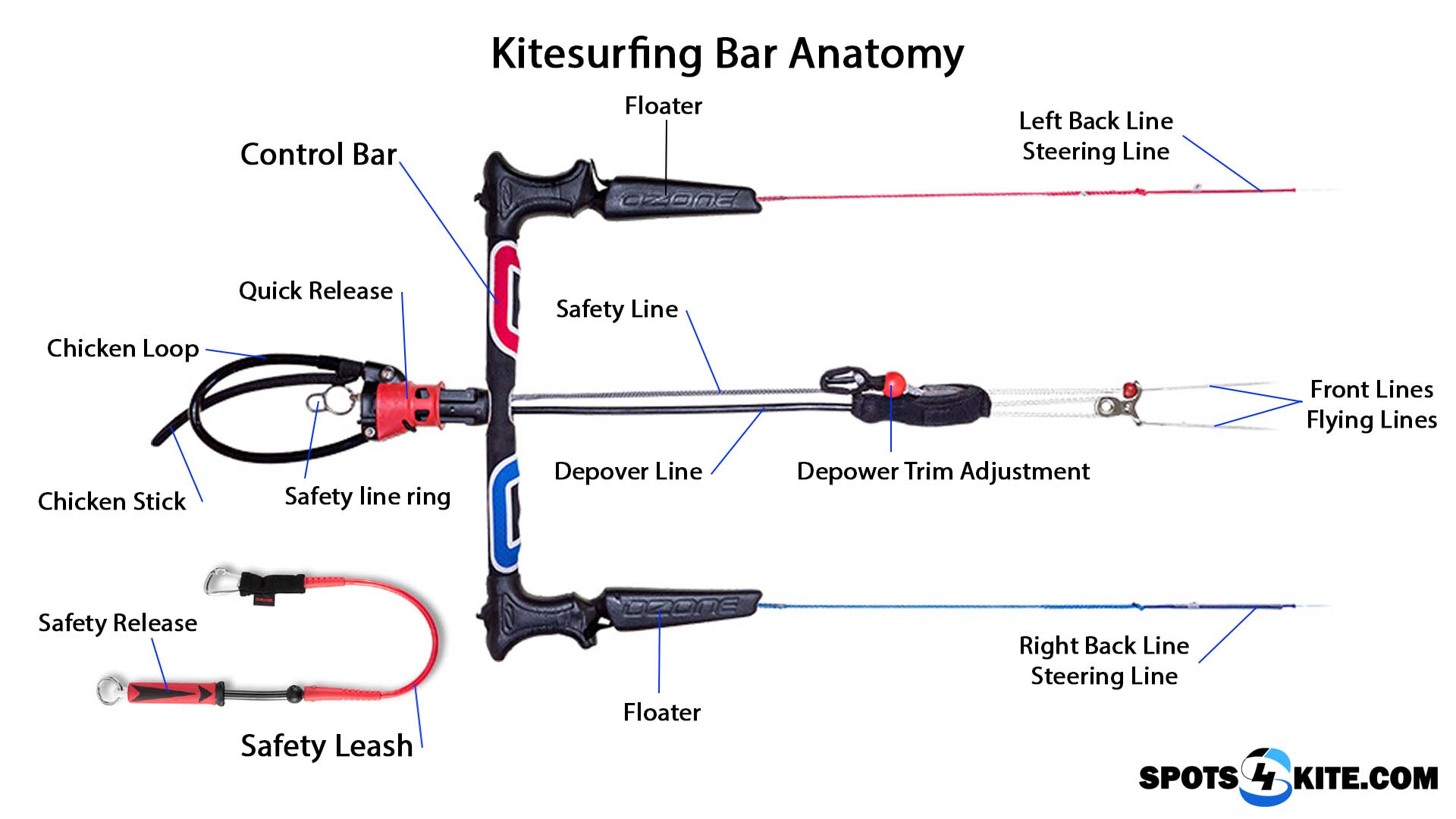
Three Levels of Safety Systems in Modern Bars
- Release the Bar: Releasing the bar from your hands is the quickest and easiest way to reduce the kite’s pull. When you start losing control of the bar, it is better to let go rather than uncontrollably pull on the bar, potentially getting the kite into an undesirable position or pull.
- Quick Release: A safety and rescue system that allows you to immediately relieve the kite of its pull and power. When activated, the bar slides away from us, and the kite remains attached only by the emergency line, which normally keeps just one line in tension and completely collapses the kite.
- Safety Release of the Kite Leash: The last safety measure is to completely detach the kite from the harness and thus from the kiter. If you have activated the quick release, you are still connected to the kite by the safety line. It may happen that the kite remains in pull, for example, due to tangled lines, and you no longer have a way to control it; at this point, it is necessary to activate the safety release on the kite leash and completely detach the kite from the kiter.

Harness
A harness is a device used to transfer and distribute the pull of the kite across the kiter’s body, thus reducing the load on the arms. It is worn around the waist and features a spreader bar with a hook at the front, where the chicken loop is attached.
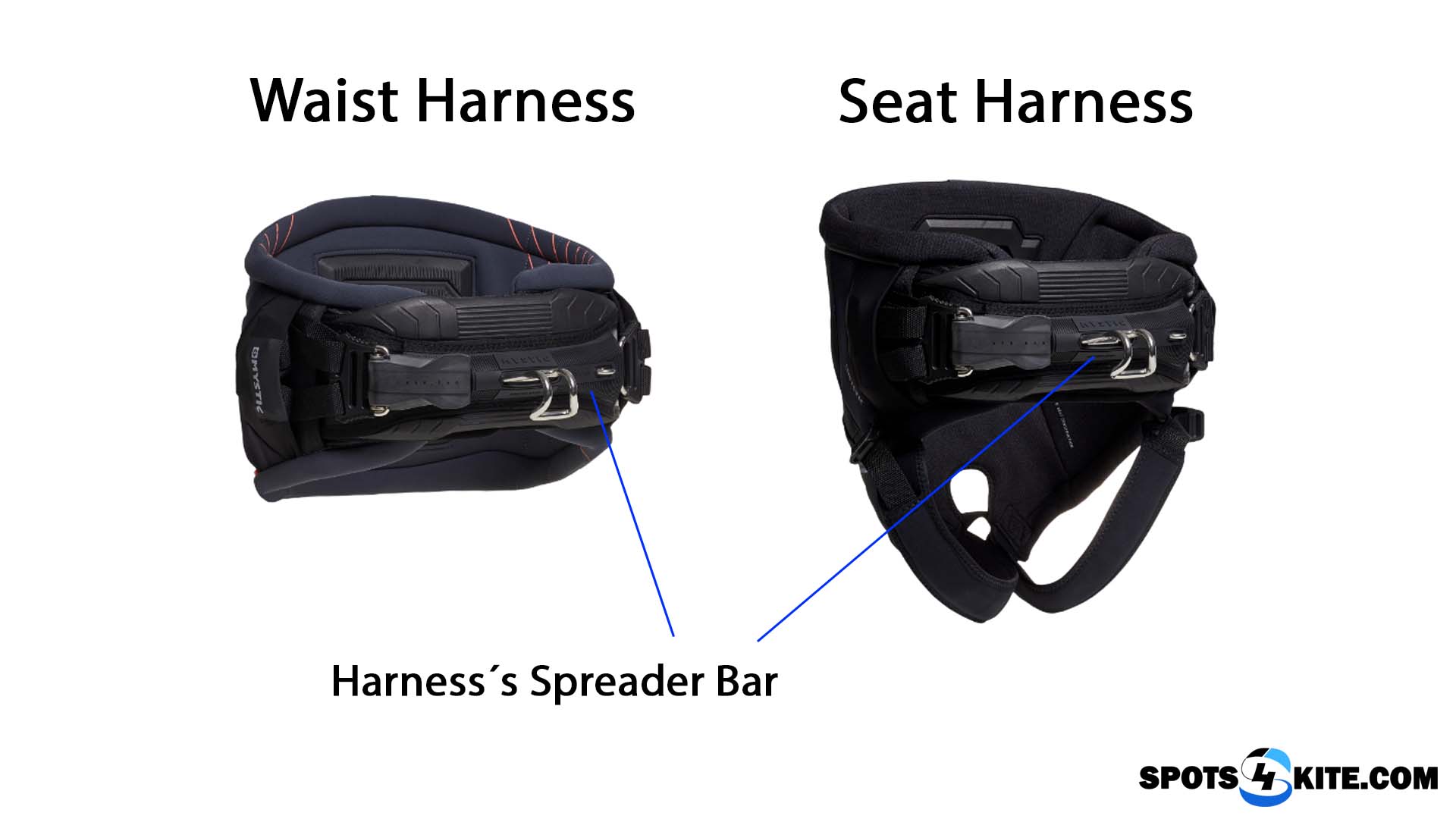
There are several types of harnesses, but the most commonly used are the Waist Harness and the Seat Harness. Both types serve the same function, but their use is entirely individual. It is crucial that the harness fits well, is comfortable for long-term wear, and does not restrict the kiter’s movements. Only then can you achieve a safe and enjoyable kitesurfing experience.
Waist Harness
The Waist Harness is the most popular type of kitesurfing harness. It consists of a wide, reinforced belt that wraps around the waist and includes a harness’s spreader bar with a hook. The harnesses are designed to hold firmly around the waist and hips, transferring the kite’s force to the lower back. A well-fitting Waist Harness sits snugly on the body while allowing greater freedom in the upper body. It is particularly recommended for experienced, active riders who prefer a dynamic style of riding. Greater upper body freedom is important for various kitesurfing maneuvers such as rotations and jumps, making the waist harness the top choice for freestylers and wave riding.
Seat Harness
The Seat Harness is an ideal kitesurfing harness for beginners, women of short stature, and children. The Seat Harness also wraps around the waist and features a spreader bar with a hook at the front, plus pre-shaped seat cups and leg straps. When there is excessive pull from the kite, the leg straps ensure comfort for children and beginners by preventing the harness from sliding up to the upper torso. This can often be uncomfortable and painful when the harness presses against the ribs or chest. If the harness rises too high, people of short stature may also have difficulty reaching the bar and controlling the kite properly. However, Seat Harnesses are not just beginner equipment; they are also valued by experienced freeriders for long distances, speed racers and kitefoiling.
Kitesurfing is an exciting blend of adventure and skill, requiring the right equipment and knowledge. We hope this article has been a valuable resource in familiarizing you with the essential gear needed for a safe and enjoyable kitesurfing experience. Stay tuned for more entries in our kitesurfing glossary series, where we’ll dive deeper into additional terms and advanced concepts to enhance your understanding in this thrilling sport.

Author: Spots4Kite
The team behind Spots4Kite.

Jon
February 6, 2026 at 12:45 pmThank you. Best summary ive come across, and ive been looking for years.
Karel
February 6, 2026 at 12:49 pmYou are welcome 🙂